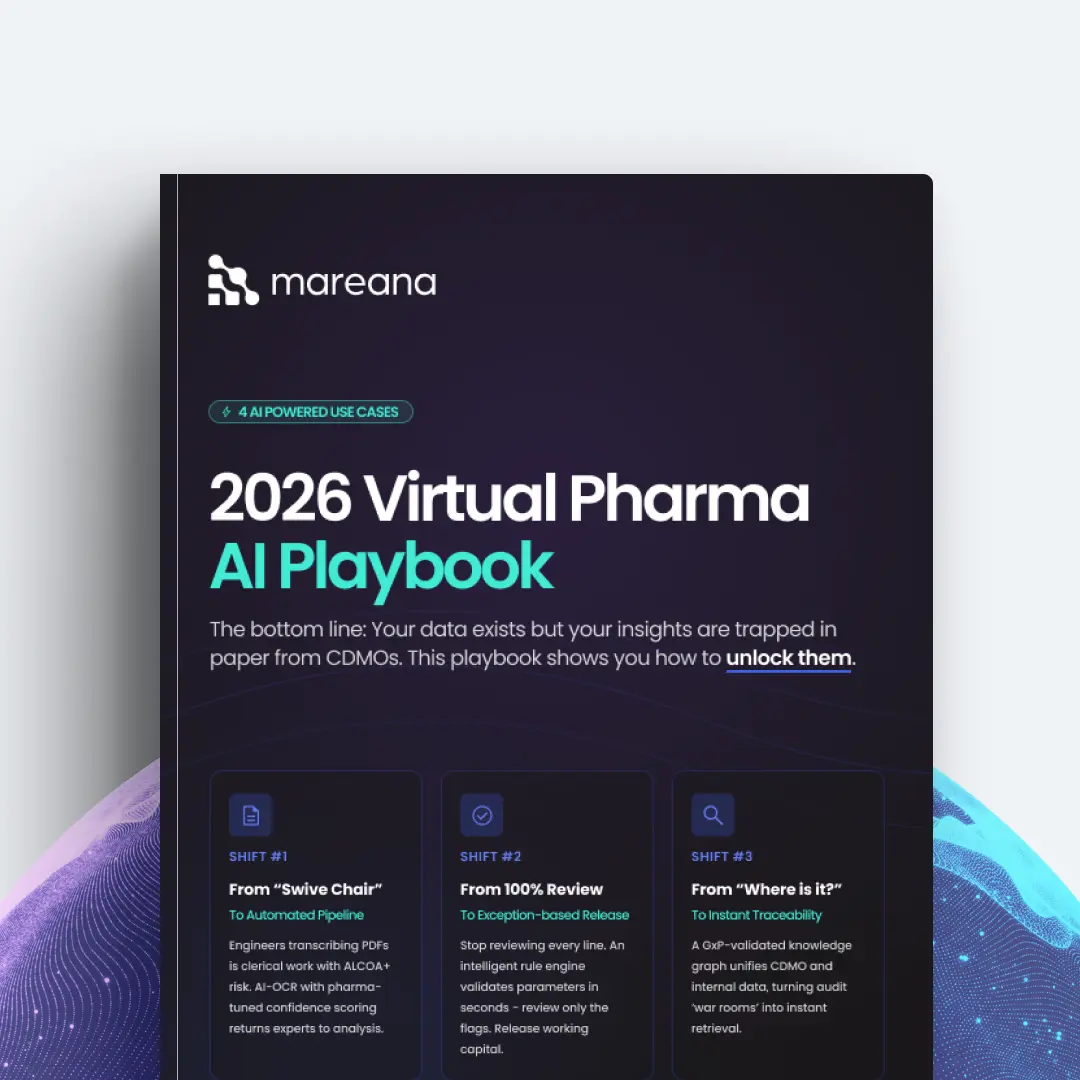






2026 Virtual Pharma AI Playbook
/ For Virtual Pharma Leaders

2026 Virtual Pharma AI Playbook

2026 Virtual Pharma AI Playbook
  • Eliminate manual transcription with pharma-tuned AI-OCR and confidence scoring.
  • Transition from line-by-line review to exception-based batch release.
  • Replace audit war rooms with instant, unified digital lineage.

Your insights are trapped in CDMO files. Here is the key to unlock them.

Download the playbook

By submitting your details, you agree to our Privacy Policy , and to receive email communications from Mareana. You may unsubscribe at any time.

Key Takeaways

With Mareana, you can transform "glued-shut" CDMO PDFs into a unified, GxP-compliant digital layer. This playbook details the specific mechanisms to replace manual transcription with pharma-tuned AI, implement exception-based batch release to unlock working capital, and utilize GraphRAG to turn audit war rooms into instant, hallucination-free retrieval

In this whitepaper, you will learn
  • How to utilize pharma-tuned vision models to transform "glued-shut" PDF batch records into queryable, structured data.

  • The mechanism for transitioning QA from 100% line-by-line review to an accelerated exception-based release workflow.

  • Strategies for automating Continuous Process Verification (CPV) to detect drift and yield loss before a batch fails.

  • How to leverage GraphRAG and Knowledge Graphs to unify internal and CDMO data for instant, hallucination-free lineage retrieval.
Good Manufacturing
Practice

Connected Data Deep Insights.

Good Manufacturing
Practice

Connected Data Deep Insights.

/ ANY QUESTIONS? WE'D LOVE TO HELP

Frequently Asked Questions

Virtual Pharma companies face a unique pressure: they outsource manufacturing but own the compliance risk. This guide addresses the specific friction of managing data that arrives in fragmented formats (PDFs, Excel) from multiple CDMO partners, creating what we call “Data Jail”.

Unlike generic tools, the mechanisms detailed in this playbook use vision models and transformers trained on pharmaceutical vocabulary. The system segments handwriting, annotations, and tables, assigning a probability score to every extraction to ensure high-risk data is verified by a human.

Companies can minimize delays by digitizing batch records, using predictive monitoring to spot deviations early, and automating compliance tasks. This ensures “first-time-right” outcomes, faster batch release, and reduced regulatory risk. 

It does not remove human oversight; it focuses it. The AI Rule Engine validates hundreds of parameters (ranges, signatures, calculations) in seconds. Your QA experts then focus solely on the “Exceptions”—the red and yellow flags—rather than fatigue-inducing routine verification.

The playbook details the use of GraphRAG (Retrieval-Augmented Generation) over a deterministic Knowledge Graph. Unlike open-ended chatbots, this architecture restricts the AI to synthesizing answers only from your validated genealogy data, ensuring every insight traces back to a specific source record.

AI reduces ALCOA+ risk by removing manual transcription and validation steps that introduce human error. Automated extraction, confidence scoring, rule-based validation, and full audit trails ensure data remains attributable, legible, contemporaneous, original, and accurate throughout the product lifecycle.

Yes—when AI is used as decision support, not decision replacement. Validated AI systems flag anomalies, validate rules, and surface insights while final decisions remain with qualified personnel. Full traceability, reviewer oversight, and audit trails ensure regulatory compliance.

Virtual pharma organizations with connected data, automated validation, and instant lineage release batches faster, pass audits with less effort, and redeploy expert talent to high-value work. This operational maturity creates a widening competitive gap versus companies relying on manual processes.

Spreadsheets require manual data entry, lack version control, and introduce transcription errors. For virtual pharma, this creates hidden compliance risk and prevents scalable analytics. Digitized, validated systems provide audit-ready traceability and reduce human error.

AI-powered data extraction and knowledge graphs allow instant retrieval of batch records, deviations, and lineage. Instead of assembling documents manually, virtual pharma teams can answer auditor questions in minutes with complete traceability back to source data.