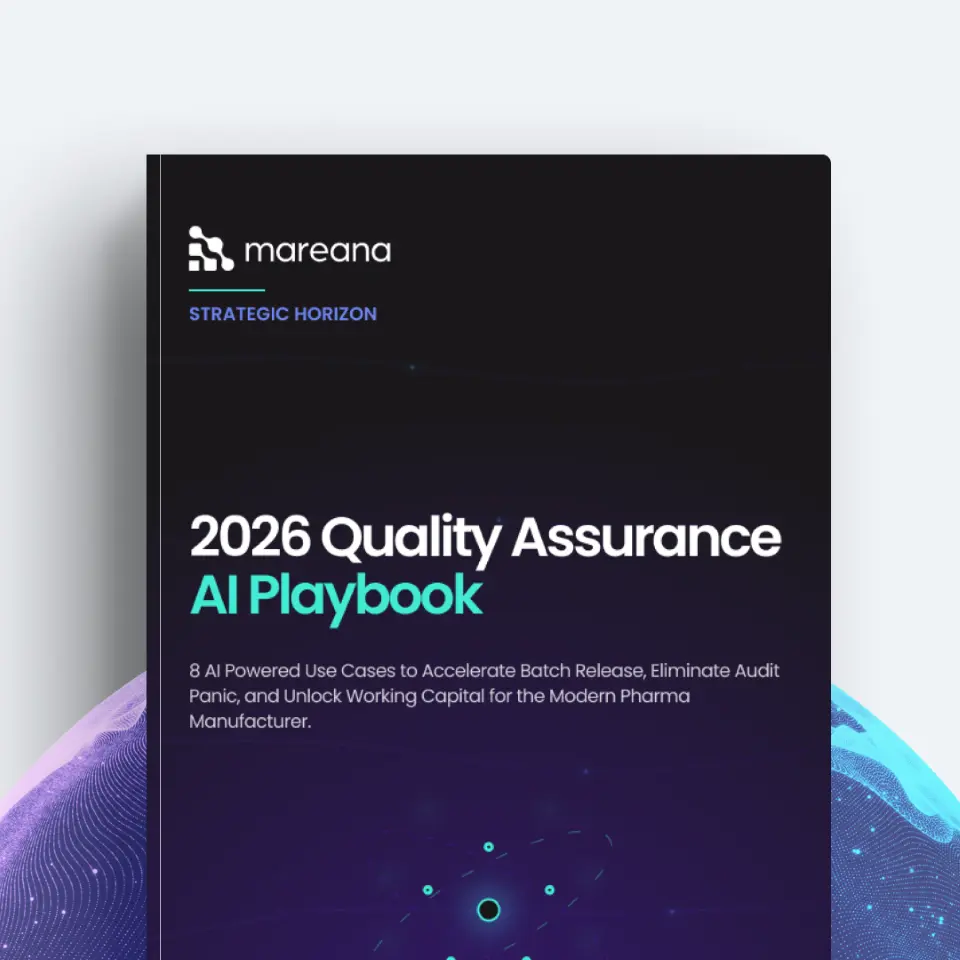






2026 Quality Assurance AI Playbook
/ 8 AI Use Cases

2026 Quality Assurance AI Playbook

2026 Quality Assurance AI Playbook
  • Transform scanned PDFs and paper records into query-ready digital data with AI-OCR
  • Shift from line-by-line review to AI-powered review by exception
  • Eliminate unvalidated Excel calculations with 21 CFR Part 11 compliant analytics

Transform your quality assurance with AI in 2026

Download the playbook

By submitting your details, you agree to our Privacy Policy , and to receive email communications from Mareana. You may unsubscribe at any time.

Key Takeaways

The pharmaceutical industry pays a hidden "Complexity Tax" for hybrid paper-digital systems, not just in man-hours and storage fees, but in trapped working capital, regulatory exposure, and lost agility. This playbook reveals how AI-driven digitization combined with knowledge graph contextualization creates a single source of truth, transforming "Dark Data" locked in PDFs into a query-ready digital twin of your product lifecycle. Quality leaders will learn practical frameworks for compressing batch release from weeks to hours, closing investigations in days instead of months, and achieving the kind of continuous inspection readiness where audits become opportunities to demonstrate excellence rather than threats to survival.

In this whitepaper, you will learn
  • The framework for shifting QA teams from brute-force verification to exception-based review using configurable AI rule engines that validate hundreds of parameters in seconds.

  • The technical architecture of pharma-specific AI-OCR that transforms unstructured batch records into contextualized data nodes within an enterprise knowledge graph.

  • The methodology for replacing "Hidden Factory" Excel spreadsheets with validated SPC charts and CPK calculations that maintain audit-ready traceability.

  • The implementation pathway for Batch Genealogy that enables instant forward/backward traceability and eliminates the document-runner scramble during regulatory inspections.
Good Manufacturing
Practice

Connected Data Deep Insights.

Good Manufacturing
Practice

Connected Data Deep Insights.

/ ANY QUESTIONS? WE'D LOVE TO HELP

Frequently Asked Questions

Paper-based batch records create three critical risk vectors: data integrity exposure, operational latency, and institutional knowledge loss. Every manual transcription point—from HMI to logbook to OEE tracker—introduces a 1-4% error rate. In a typical 500-page batch record, this guarantees dozens of errors per batch, transforming quality management into an exercise in managing statistical human failure. Regulators increasingly cite “Dark Data” trapped in scanned PDFs as ALCOA+ violations because this information cannot be queried, trended, or audited without manual re-entry. The solution requires pharma-specific AI-OCR capable of extracting handwritten values, nested tables, and multi-signature blocks while automatically contextualizing each data point within a knowledge graph that links materials, operations, and outcomes. 

Batch release latency stems from a quality philosophy that emphasizes “reviewing in quality” rather than “manufacturing in quality.” QA acts as a downstream filter, receiving massive batch records only after production concludes. Reviewers must manually verify thousands of entries, check every signature, and recalculate yields—a brute-force approach where 80% of time is spent on conformant data that requires no action. For blockbuster drugs, each day of delay costs $1M-$8M in trapped working capital. Exception-based review changes this equation: AI rule engines validate conformant data against established ranges and calculations automatically, highlighting only red/yellow exceptions for human review. Combined with real-time validation during production, this compresses release from weeks to hours while evolving reviewers from “checkers of text” into “auditors of process.” 

The “Hidden Factory” of Excel represents a ticking compliance bomb. When enterprise systems prove too rigid or expensive to configure, engineers inevitably turn to spreadsheets for CPK calculations, yield adjustments, and stability trending—creating a shadow IT ecosystem that lives outside QMS purview. Industry data shows 88-90% of spreadsheets contain significant errors (formula, logic, or data), yet lack the robust audit trails, version control, and security required by 21 CFR Part 11. Recent FDA 483 observations explicitly cite “uncontrolled electronic spreadsheets” and “fabrication via Excel” as major findings. The remediation path requires validated analytics platforms that ingest data directly from LIMS/MES sources, apply pharmaceutical-standard statistical rules (Nelson, Westgaard), and maintain immutable calculation trails—replacing “trust” with “proof.” 

Data integrity violations arise from compliance friction—when doing the right thing becomes significantly harder than taking shortcuts. Operators facing aggressive quotas develop workarounds: shared passwords to bypass login delays, pre-filled records to save time, disabled audit trails to mask errors. A single Warning Letter citing 21 CFR 211.68 can trigger Import Alerts, Consent Decrees, and remediation costs exceeding $50-100 million. The solution requires technical governance over procedural trust: tamper-evident digital trails with cryptographically linked timestamps that make backdating technically impossible, strict role-based access controls integrated with SSO/biometrics, and GraphRAG architectures that provide traceability for every insight back to source data—eliminating “black box” risks while proving to auditors that decisions rest on validated information. 

Investigation cycle time bloats because evidence is fragmented across disconnected systems. To identify a root cause, investigators need LIMS test results, MES process parameters, BMS environmental data, and supplier COAs—but these systems don’t communicate. Consequently, 80% of investigation time goes to data gathering, not analysis. Under deadline pressure, investigators settle for superficial conclusions (“Human Error” appears in 50%+ of investigations) rather than identifying systemic issues. This drives CAPA death spirals where true root causes remain unaddressed. Knowledge graph architectures change this equation by enabling instant Genealogy Exploration: visualizing complete batch history, tracing deviations backward to raw materials or forward to affected batches, and surfacing historical precedents through natural language queries. Investigations close in days, not months, while organizations move from blame to systemic prevention. 

The “War Room” approach to audits—mobilizing SMEs, dispatching document runners, storyboarding narratives—reveals a fundamental gap between being compliant and proving compliance. Evidence scattered across physical archives, shared drives, and individual inboxes transforms auditor requests into forensic scavenger hunts. If a document can’t be produced in 15-30 minutes, auditors assume it doesn’t exist. Continuous readiness requires a unified digital thread: Batch Genealogy that maps complete product lifecycles as queryable graphs, AI-driven digitization that makes even historical paper records searchable, and GraphRAG interfaces that enable “pre-auditing” through natural language queries. The result: zero prep time, zero operational disruption, and the confidence to welcome inspections as opportunities to demonstrate excellence.