Key takeaways
- A review procedure says how batch records are reviewed, and the review criteria say what each record must show. Neither holds where an experienced reviewer looks harder.
- 21 CFR 211.22(d), 211.192, PIC/S and MHRA all require written procedures and review against them. None of them asks for that extra knowledge a senior reviewer knows in writing.
- That unwritten knowledge is part of why two qualified reviewers can return different findings from the same record.
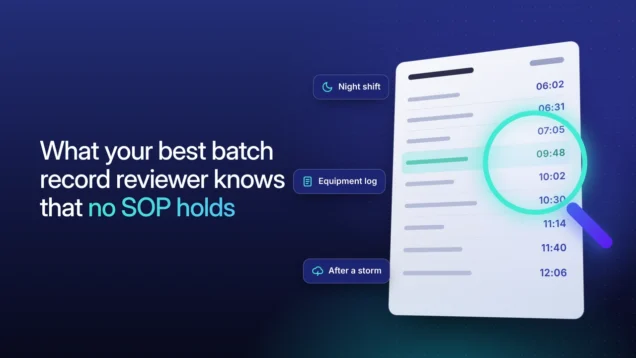
Think of what a reviewer means, when they say somebody knows the record. She works from the same procedure and the same checklist as everyone else. She also looks harder in a few places that neither document mentions.
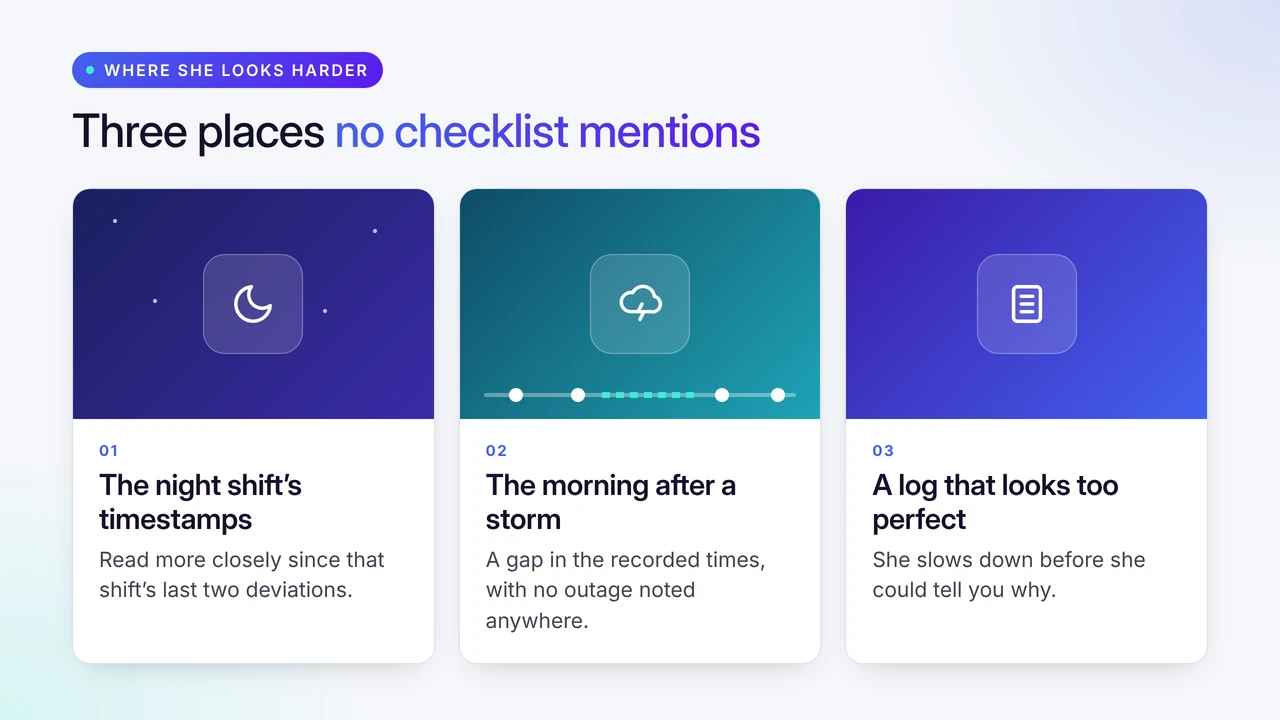
Since the last two deviations on the night shift, she reads that shift’s timestamps more closely than the checklist asks. On the morning after a storm, she looks for a gap in the recorded times, and on one record she finds one, with no outage noted anywhere. When an equipment log looks too perfect, she slows down before she could tell you why. She applies all three to every batch she reads.
Here is what a site writes down for batch record review, what it leaves out, and why that gap matters.
Three things a site writes down, and one it doesn’t
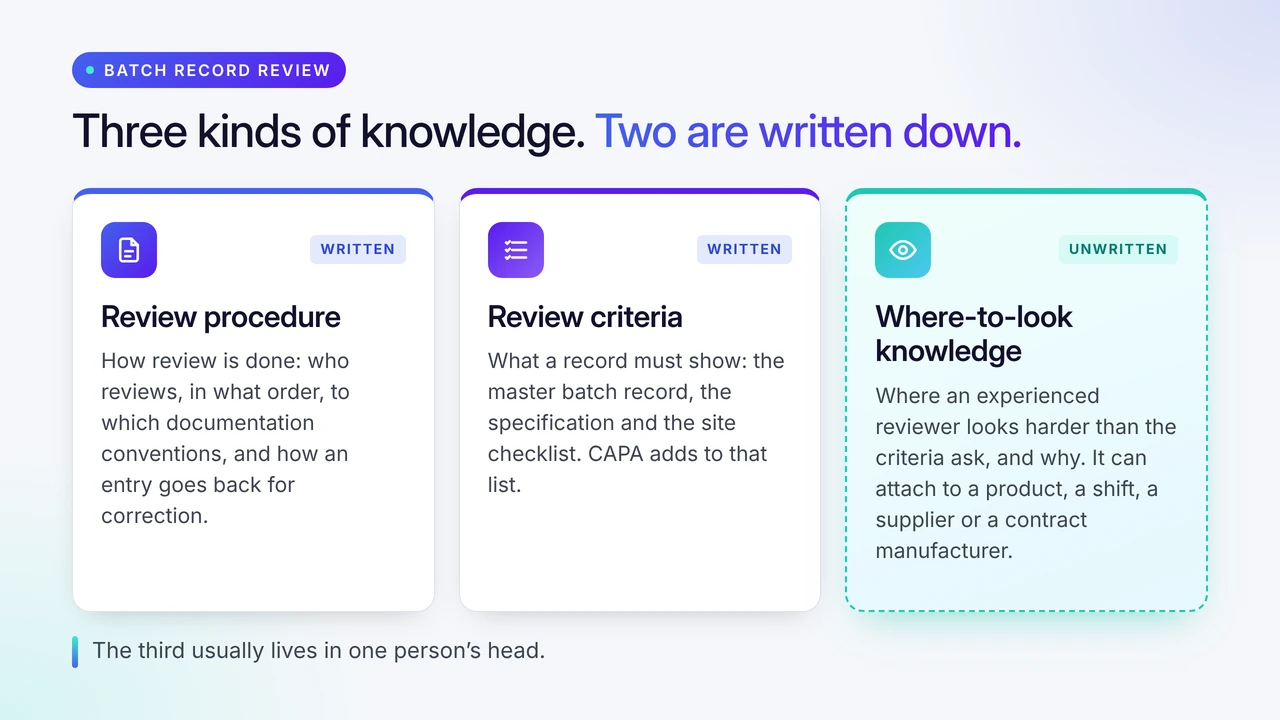
Batch record review rests on three kinds of knowledge. Two of them are written down and controlled. The third usually lives in one person’s head.
First, the review procedure says how review is done: who reviews, in what order, to which documentation conventions, and how an entry goes back to the person who made it for correction.
Second, the review criteria say what a record must show. They start with the master batch record, the approved template that sets each step and its ranges and changes only through change control. Next come the specification, which sets the limits, and the site checklist, which lists what a reviewer confirms on every record. When something goes wrong, CAPA (corrective and preventive action) adds to that list.
Third, and unwritten: where-to-look knowledge. Where-to-look knowledge is where an experienced reviewer looks harder than the written criteria ask, and why, learned from what has gone wrong before. It can attach to a product, and just as often to a shift, a supplier or a contract manufacturer.
None of our reviewer’s three places is on the checklist. Two of them followed no deviation, so no CAPA was ever raised for them. Each started with something on a record that surprised her, and each has outlasted the event behind it. What one record taught her travels with her to the next.
Nothing asks for that third kind of knowledge to be written down. The regulations show why.
What 21 CFR 211.192, PIC/S and MHRA require in writing
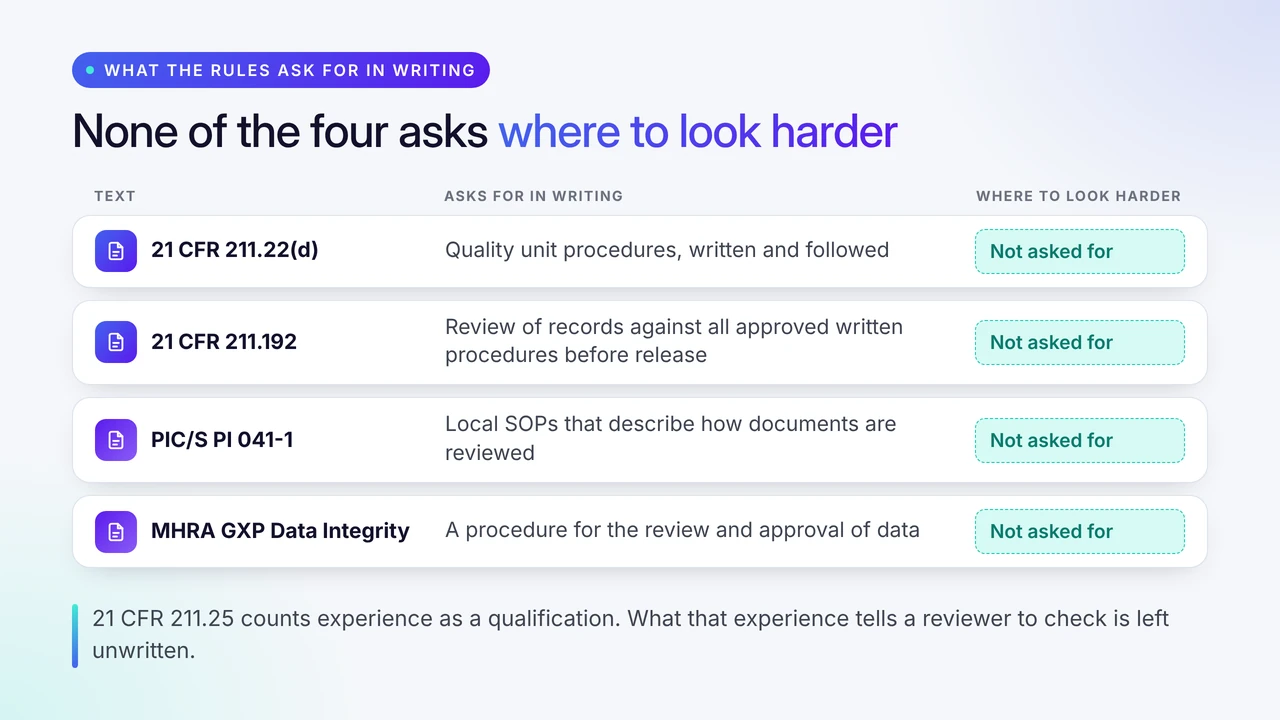
Four texts set the rules for batch record review, and they ask for two things in writing: the procedures, and review against them. 21 CFR 211.22(d) requires the quality unit’s procedures to be written and followed. 21 CFR 211.192 requires records to be reviewed against all approved written procedures before a batch is released. PIC/S and MHRA ask for the review process itself to be written. None of them asks for the places a reviewer looks harder.
In the regulation’s own words, 21 CFR 211.22(d) says “the responsibilities and procedures applicable to the quality control unit shall be in writing; such written procedures shall be followed.” 21 CFR 211.192 has the quality unit review and approve production and control records “to determine compliance with all established, approved written procedures” before a batch is released or distributed.
Outside the US, PIC/S PI 041-1 (2021) expects local SOPs that describe how documents are reviewed, and inspectors check that data “was critically compared to the acceptance criteria.” The MHRA GXP Data Integrity Guidance (2018) expects “a procedure that describes the process for review and approval of data.”
As close as any text comes is 21 CFR 211.25, which asks for “education, training, and experience” to do the job. Experience counts as a qualification. What that experience tells a reviewer to check is left unwritten.
ICH Q10 widens the lens to the whole quality system. It treats knowledge management as an enabler and names “manufacturing experience” as a source of knowledge, though it never mentions batch record review. Applying that idea to where a reviewer looks harder is our own extension of ICH Q10.
Our whitepaper, What Your Best Reviewer Knows, reads these texts side by side, including what each one asks of a sponsor and of a contract manufacturer, and shows which part of a reviewer’s unwritten knowledge can be turned into a written check.
What FDA says batch record review depends on
FDA has been plain about what review depends on. An aseptic intervention is an action an operator takes inside the sterile filling area, such as adjusting equipment, and the batch record is where it should be recorded. In an August 2026 warning letter to a contract manufacturer of sterile injectables, investigators found a batch record that recorded twelve aseptic interventions. Other records showed about two hundred.
FDA wrote that incomplete records “fundamentally compromise your ability to reliably conduct batch record review.”
That was one batch at one site, and investigators found it by comparing the batch record with other records. Even as a single case, it makes a simple point plainly: review is only as reliable as the record in front of the reviewer.
Review also depends on the person reading. A reviewer can only check what the record shows, and what she knows to check it against. Two reviewers can hold the same record and the same checklist and still check different things, because each brings a different sense of where to look.
Why two qualified reviewers find different things
Reviewer consistency is the degree to which two qualified reviewers, applying the same procedure and the same written criteria to the same record, return the same findings. Part of why they differ is that each has learned where to look from what they have seen go wrong.
Take a deviation on the night shift. The quality system investigates, CAPA corrects the cause, and a check may be added to the site checklist. Our reviewer takes a second route: for months she reads that shift’s timestamps harder, until its records have run clean for long enough. A CAPA’s effectiveness check, a closer look for a set period to confirm the fix worked, may capture part of that attention. Hers started before the CAPA was raised and lasts after the check closes.
New reviewers pick this up by watching. PharmaLex’s example training plan for batch record reviewers (2018) starts with observing a trained reviewer, then moves to supervised review “until training effectiveness demonstrated.” It’s a sound plan. Where a new reviewer learns to look harder, though, depends on whoever they happened to watch.
Second-person review is where the difference surfaces. That’s the step where a second reviewer, often in the quality unit, reads a record after production has. On the returns sheet, the form used to send an entry back for correction, one reviewer returns a kind of entry another never does.
What it costs when one person knows where to look
Where she looks harder stays out of sight until she stops reviewing. A retirement does that. So does a promotion, a move to another site, or a year on a technology transfer. The records keep arriving, and a reviewer who never watched her reads them against the same criteria, correctly, without the extra look. What left with her shows up, if it shows up at all, as an entry she would have returned, found later by somebody else.
The cost shows up in a few ways. Somebody senior re-reads a newer reviewer’s records until the two converge. Returns go out that another reviewer wouldn’t have raised, and records wait for the one person who knows them. Some closer looks never happen, because nobody told the newer reviewer to make them. No published source the whitepaper found measures any of this, or how long a new reviewer takes to catch up.
What a site can do about it
Our latest whitepaper “What your best reviewer knows”, sets out which part of this knowledge can be written as a check, where that check belongs, and three next steps with an owner for each. It closes with a worksheet to run with the reviewer you’d miss most.



 Learn more