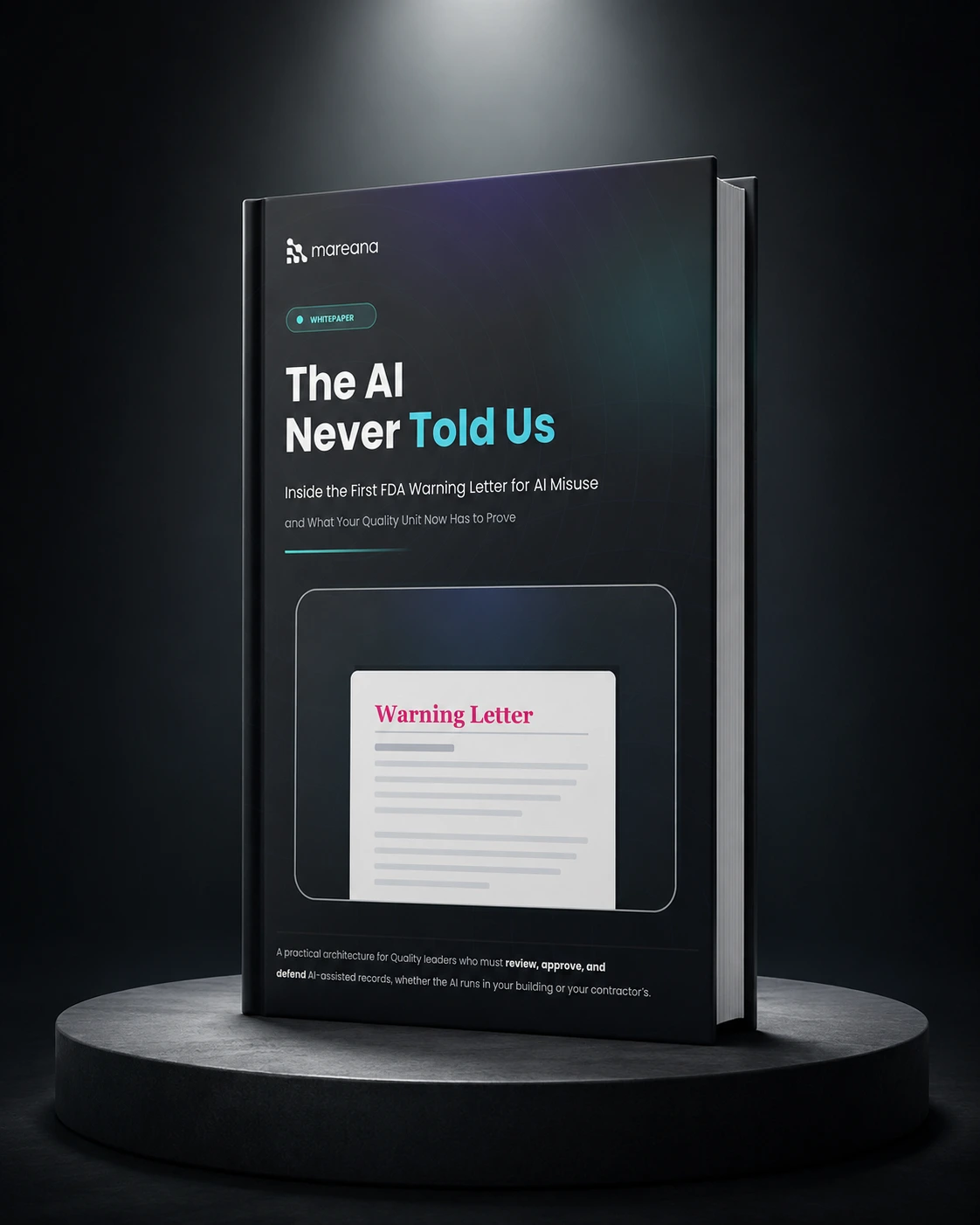






The AI Never Told Us: Lessons from the First FDA Warning Letter on AI Misuse
/ AI Under Scrutiny

The AI Never Told Us: Lessons from the First FDA Warning Letter on AI Misuse

The AI Never Told Us: Lessons from the First FDA Warning Letter on AI Misuse
  • Establish a more compliant approach to AI adoption
  • Reduce risk associated with unvalidated AI outputs
  • Strengthen Quality Unit oversight and accountability

Audit readiness for AI-assisted workflows

Download the white paper

By submitting your details, you agree to our Privacy Policy , and to receive email communications from Mareana. You may unsubscribe at any time.

Key Takeaways

With Mareana, you can implement AI in regulated manufacturing environments while maintaining human oversight, auditability, traceability, and compliance readiness.

In this whitepaper, you will learn
  • Why the first FDA AI-related warning letter matters to manufacturers

  • Why data lineage and contextualized records are critical for AI success

  • Best practices for validation, governance, and human oversight

  • What FDA investigators are likely to ask about AI during inspections
Good Manufacturing
Practice

Connected Data Deep Insights.

Good Manufacturing
Practice

Connected Data Deep Insights.

/ ANY QUESTIONS? WE'D LOVE TO HELP

Frequently Asked Questions

Pharmaceutical companies should use a risk-based validation approach that includes clearly defined contexts of use, documented acceptance criteria, audit trails, change control, and human oversight. Validation rigor should increase as AI influence on GMP decisions increases. Organizations should also maintain traceability between AI outputs, source data, reviewer actions, and final approvals to satisfy FDA expectations and inspection requirements.

The whitepaper identifies five likely FDA inspection questions:

  1. Show your inventory of AI use in cGMP activities.
  2. Show how AI-assisted records were reviewed before release.
  3. Explain how you control AI hallucinations.
  4. Demonstrate how you govern AI use at CDMOs.
  5. Show how Quality Unit personnel are trained to review AI outputs.

Companies that cannot produce evidence-based answers and audit trails may face significant compliance risk.

An AI-assisted record is one where AI helps draft or analyze content, but an authorized Quality Unit reviewer independently verifies the information and applies regulatory judgment before approval. An AI-generated record is one where AI-created content enters the quality system without substantive human review. According to the whitepaper, FDA enforcement focuses on preventing the latter because Quality Unit accountability cannot be delegated to AI.

The biggest AI compliance risk is that sponsors remain fully accountable for AI-generated content created by contract manufacturers (CDMOs), even when the AI system operates outside the sponsor’s organization. If a CDMO uses generative AI to create batch records, deviations, CAPAs, or specifications without adequate review, the sponsor may inherit the resulting regulatory exposure. The whitepaper refers to this as sponsors “inheriting the gap” created by AI governance weaknesses.

Yes, the FDA allows the use of artificial intelligence (AI) in pharmaceutical manufacturing, but AI-generated content cannot bypass Quality Unit review requirements. Under 21 CFR 211.22(c), authorized Quality Unit representatives must review and approve procedures, specifications, and records that affect product quality, identity, strength, or purity. The April 2026 FDA warning letter clarified that AI-generated outputs are subject to the same cGMP requirements as human-generated content.

Yes. Industry experts view the April 2026 warning letter as a milestone enforcement action that confirms existing cGMP requirements apply to AI-generated outputs. The FDA did not create a new AI regulation; it demonstrated that Quality Unit review obligations already extend to AI-generated procedures, specifications, and manufacturing records. Organizations should expect increased scrutiny of AI governance, validation, oversight, and auditability during inspections. 

Quality Units can remain compliant by implementing four foundational capabilities:

  1. Ingest and digitize records from CDMOs.
  2. Create end-to-end data lineage and traceability.
  3. Apply deterministic validation rules with confidence scoring.
  4. Maintain exception-based human review supported by immutable audit trails.

This architecture enables sponsors to execute their obligations under 21 CFR 211.22(c) even when AI-generated content originates outside their organizational boundaries.

8 AI use cases to transform your quality assurance.
/ BEFORE YOU GO

8 AI use cases to transform your quality assurance.

By signing up, you agree to the Privacy Policy.