Key takeaways
- What an experienced reviewer knows about where to look has two halves: finding, which can be written as a check, and judging, which stays with her.
- Once written, a check stops depending on one person’s memory: it can be compared, questioned and reused.
- Three questions, put to the reviewer your site would miss most, are enough to start.
Picture the senior reviewer your site relies on most. A site’s SOPs and checklists sit under document control. Where an experienced reviewer looks harder is usually written nowhere. It lives in one person’s habits, and it leaves when she does.
This post uses her three places as examples throughout: the night shift’s timestamps since its last two deviations, a gap in the times on the morning after a storm, and an equipment log that looks too perfect. The aim is practical. By the end, you’ll know which part of what she knows can be written down, and how to start.
Finding and judging: the two halves of what a reviewer knows
Where-to-look knowledge has two halves. Finding is knowing where to look and what to compare, and the reviewer who knows it can write it as a check. Judging is deciding what the result means, and it stays with the person.
Once the finding half is written and shared, any qualified reviewer can apply it. That includes whoever reads the record while she’s on leave.
Judging is where an experienced reviewer’s years count. It’s part of what separates a reviewer of ten years from one of ten weeks, and it’s built one record and one surprise at a time. She is the author of the first half and the owner of the second.
This kind of knowledge already has a name. Tacit knowledge is what a skilled person knows and applies without having it written down, often without being able to list it when asked; some teams call it tribal knowledge. In batch record review, knowing where to look is its plainest example.
You can see it in how a senior reviewer answers questions. Ask her what she checks, and she may recite the checklist. Ask about an entry she returned last week, and she’ll explain it by where she looked and what made her look there. That second answer is the one worth writing down.
Three examples, split into finding and judging
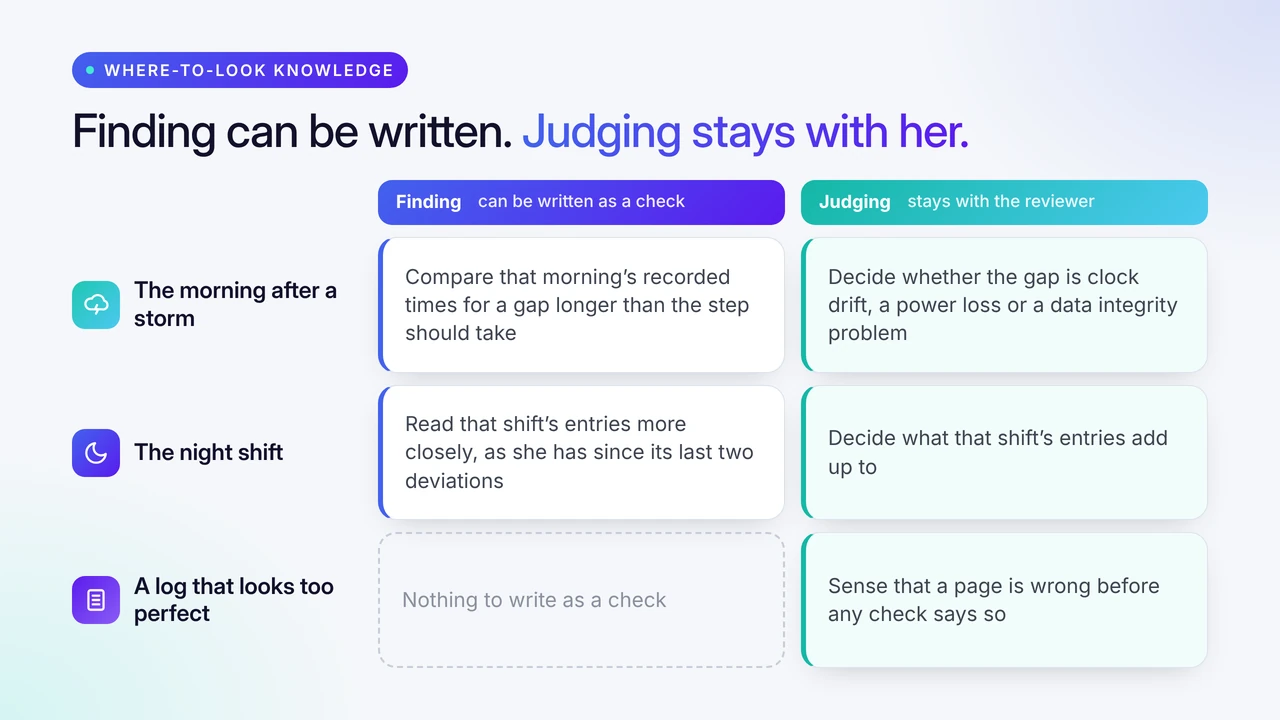
Most places a reviewer looks harder have both halves. A few are judgment all the way through.
Start with the storm. Spotting a gap in the times that morning is finding. It means comparing the times on that morning’s records and looking for a gap longer than the step should take. The storm is the reason to look. That comparison could be written as a check. Deciding whether the gap is clock drift, a power loss or a data integrity problem is judging.
Between the two sits the night shift. Her closer reading of that shift’s entries, kept up since its last two deviations, can be written as a check. What she makes of the results can’t; that part is judgment.
An equipment log that looks too perfect is judging from start to finish. It’s the sense that a page is wrong before any check says so.
Naming the halves protects the part that is hers alone: what the storm gap means, whether the log is too perfect, what the night shift’s entries add up to. Writing down the finding half asks her to give up none of it.
Why a written check holds up better
A check with a written definition can be applied the same way by a second reviewer, questioned, and used again on the next record. A check held only in one reviewer’s habits can’t be compared with anyone else’s.
Direct evidence from batch record review is thin. There is no published study of agreement between GMP batch record reviewers. The nearest measured evidence comes from hospital medical record review, and it’s useful here only as an analogy.
In a 2018 study in PLoS One, a review committee at a Dutch university hospital re-examined fifty records it had already reviewed, without seeing its first verdicts. The committee was much more consistent in identifying whether an adverse event had occurred, which had a clear definition, than in deciding whether it could have been prevented, which had no clear definition. The authors suggest this difference may be linked to the lack of a clear definition.
It helps to see why the two questions differ. Whether an adverse event occurred has a written definition, every reviewer can apply. Whether it was preventable has none, so each reviewer answers from their own experience. Those two questions sit close to finding and judging.
For a quality unit, practical reading is modest. Writing the finding half down gives a second reviewer something to apply, and something to question.
Where a written check belongs
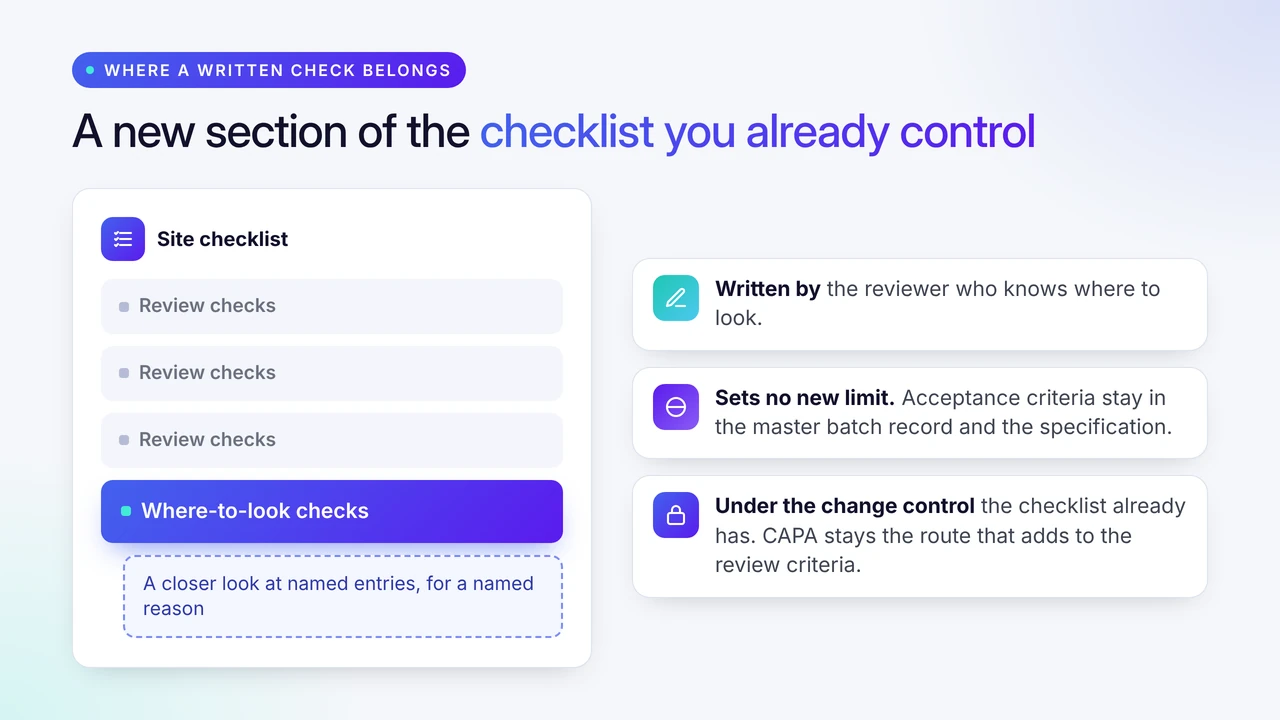
A written check needs a home the site already controls. The site checklist is the natural candidate: it sits at site level, above any single product, and it’s already under document control. It was simply never asked to hold where an experienced reviewer looks harder. This blog proposes a section of that existing checklist, rather than a new document for each product.
An entry in that section, a where-to-look check, directs a closer look at named entries for a named reason. The acceptance criteria stay in the master batch record and the specification. The reviewer who knows where to look writes it, and it sits under the change control the checklist already has. CAPA stays on the route that adds to the review criteria.
For a sketch of that section, see our whitepaper, What your best reviewer knows, which shows the checklist section and explains who signs an entry in and who retires it.
What a review system changes, and what it doesn’t
Where a written check runs also changes what it can do. A reviewer’s attention is limited, which is why she rations hers. In Batch Review Copilot, rules run every check the record requires, on every page of every batch. Her check on one shift’s timestamps, once written, runs on every shift’s records, including while she’s away, and it applies the same criterion on page 200 as on page 1.
A check reaches the rule set only when she adds it; the system doesn’t find out where she looks on its own. It finds only what it was written to find. The log that looks too perfect is still hers to judge. Judgment on what it flags stays with people: QA reviews and signs, and nothing is released without a signature.
Three questions for the reviewer you’d miss most
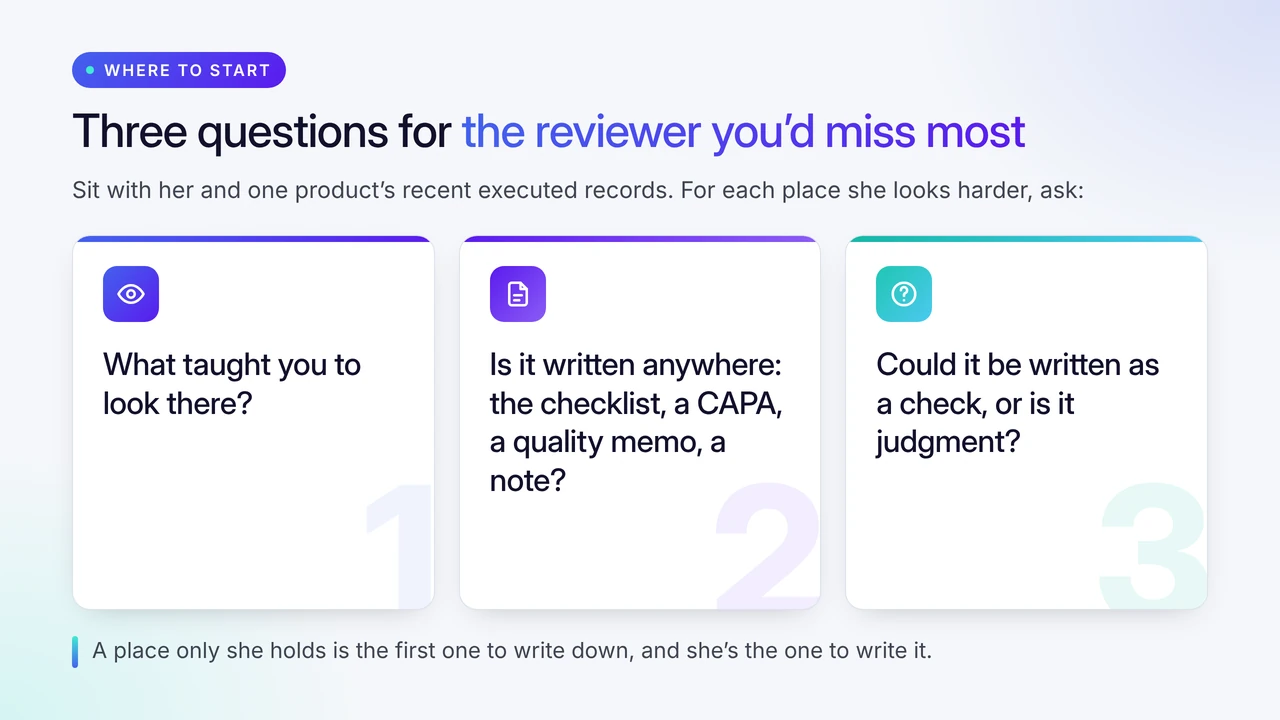
Capturing where an experienced reviewer looks harder starts with a conversation. Begin with the reviewer your site would miss most, one product, and its recent executed records. Some of her places will belong to the product itself; others to a shift, a supplier or a contract manufacturer.
Work from those records rather than from memory at a desk. Part of what she knows surfaces only when a record calls for it, so sitting with real entries brings out places she wouldn’t think to list.
For each place, ask her three questions:
- What taught you to look there?
- Is it written anywhere: the checklist, a CAPA, a quality memo, a note?
- Could it be written as a check, or is it judgment?
Expect some places to be written already. A place written in three documents, each slightly different, is an answer too, because it shows the place is already written, three slightly different ways. A place only she holds is the first one to write down, and she’s the one to write it.
While you’re at it, the whitepaper also shows how a site’s own recent second-review returns can give it a first count of what the difference between reviewers adds.
Take the worksheet into that conversation
The full whitepaper includes a worksheet that sets out these three questions for each place, with a column for who holds it. It also covers where the written checks go and three next steps, each with an owner.
Frequently Asked Questions
- What taught you to look there?
- Is this knowledge documented anywhere?
- Can it be written as a repeatable check, or does it require judgment?



 Learn more