Why Traditional Tools Fall Short and How Modern Platforms Redefine What’s Possible
Summary : Traditional batch review software can no longer keep up with the growing complexity of modern life sciences manufacturing. As data volume, system fragmentation, and compliance requirements increase, older tools fall short, resulting in slow batch release cycles, high manual workloads, and greater regulatory risk. Incremental fixes or additional staffing don’t solve the core issue: disconnected data and lack of automation.
Understanding the Core Purpose of Batch Review Software
In life sciences manufacturing, batch review software is meant to streamline the release process, reduce human error, and ensure every product meets regulatory and quality expectations. At first glance, it seems like a straightforward function: collect batch data, compare it to specifications, and document the outcome.
But in practice, the complexity behind this process has expanded dramatically. Traditional tools built in an era of simpler operations are struggling to keep up. Modern manufacturing moves faster, handles more data, and requires real-time insight rather than post-production paperwork.
The Hidden Complexity Behind Today’s Life Sciences Manufacturing
Rising Data Volume and Velocity
Manufacturing data once existed in isolated logs or paper records. Now, biopharma and advanced therapy facilities generate:
- Continuous sensor data
- High-resolution historian feeds
- Automated equipment logs
- LIMS, MES, ERP, and QMS datasets
Older batch review software simply wasn’t designed for high-velocity, real-time data streams. It expects static records at the end of a batch, not constant streams of contextual information.
Fragmented Systems and Siloed Operations
Many manufacturers still work with disconnected systems that struggle to “talk” to each other:
- MES data in one place
- LIMS data elsewhere
- Paper or PDF batch records on shared drives
This fragmentation forces QA to perform a massive amount of manual data chasing. It’s not inefficient because people are slow. It is also inefficient because the tools don’t provide context.
The Expanding Compliance Burden
Regulatory expectations around data integrity, traceability, and audit readiness have intensified.
Yet conventional batch review software often lacks:
- Immutable audit trails
- Automated verification logic
- Historical trend comparison
- Intelligent cross-system analytics
This increases both workload and risk.
Challenges That Undermine Traditional Batch Review Software
Slow Review Cycles and Release Delays
Many teams still spend weeks reviewing a single batch largely because conventional systems rely on:
- Manual checks
- Repetitive validation steps
- Document-level review instead of data-level insight
These delays directly affect inventory, working capital, and the ability to supply patients quickly.
Manual Data Reconciliation and Human Error
When data lives across systems, QA reviewers must manually extract, compare, and validate thousands of values. This leads to:
- Higher rates of transcription errors
- Missed deviations
- Excessive investigations
Poor System Integration and Incomplete Context
Traditional solutions rarely create a complete view of a batch. Instead, reviewers must piece together a narrative across disconnected sources.
Inability to Handle Real-Time, High-Velocity Data
First-generation EBR systems weren’t built for modern IoT and PAT-driven processes. They cannot:
- Ingest raw high-frequency signals
- Process anomalies in real time
- Support continuous verification or real-time release
This is becoming a critical limitation for ATMPs and biologics.
Operational & Economic Consequences of Outdated Approaches
Workforce Burnout and Alert Fatigue
Highly trained QA professionals end up spending most of their time:
- Verifying signatures
- Hunting for missing records
- Reviewing low-risk, repetitive checks
This isn’t just inefficient, it’s demoralizing.
Inefficient Deviation Investigations
Fragmented systems and missing context make investigations slow and incomplete. Teams struggle to “rebuild” the batch days or weeks after events occurred.
Higher Cost of Quality and Greater Regulatory Risk
Manual processes increase:
- Cost of appraisal
- Cost of non-conformance
- Severity of regulatory findings
Why Incremental Fixes Don’t Solve the Problem
Limitations of First-Generation EBR Systems
EBR systems digitized paperwork. They didn’t modernize the process. They still force teams to perform:
- Manual comparisons
- Manual verifications
- Manual data cross-checks
Why More Staffing Isn’t the Answer
Adding people increases labor costs but doesn’t reduce bottlenecks. The root issue is not capacity, but data fragmentation and lack of automation.
What a Modern, Intelligent Approach Must Deliver
True transformation requires a system that can provide:
- A Unified Data Foundation
This means all batch-related data including process, material, equipment and quality exists in one harmonized, contextualized layer.
- AI-Enabled Review by Exception
Instead of reviewing thousands of data points, QA should see only meaningful exceptions.
- Digital Traceability and End-to-End Lineage
Reviewers should be able to trace any deviation back to its source within seconds.
How Mareana Moves Beyond Legacy Batch Review Software
Mareana is not another batch review software, but it’s a manufacturing intelligence platform designed to overcome challenges traditional tools cannot.
- Automating Review with Batch Release Copilot
Batch Release Copilot transforms manual review into automated, exception-based oversight. - Solving Fragmentation with Batch Genealogy
Batch Genealogy creates a visual, end-to-end map of all production data.
This eliminates manual data chasing and accelerates investigations. - Accelerating Root Cause Analysis with Neptune
Neptune’s generative AI synthesizes context and data from across the knowledge graph, letting teams resolve issues in minutes—not days. - From Reactive to Proactive Quality with Smart CPV
Smart CPV predicts deviations before they occur, aligning with the industry move toward real-time release. - Reducing Compliance Burden with Auto APQR
Auto APQR generates audit-ready reports in hours instead of months.
Watch AI powered batch review in action
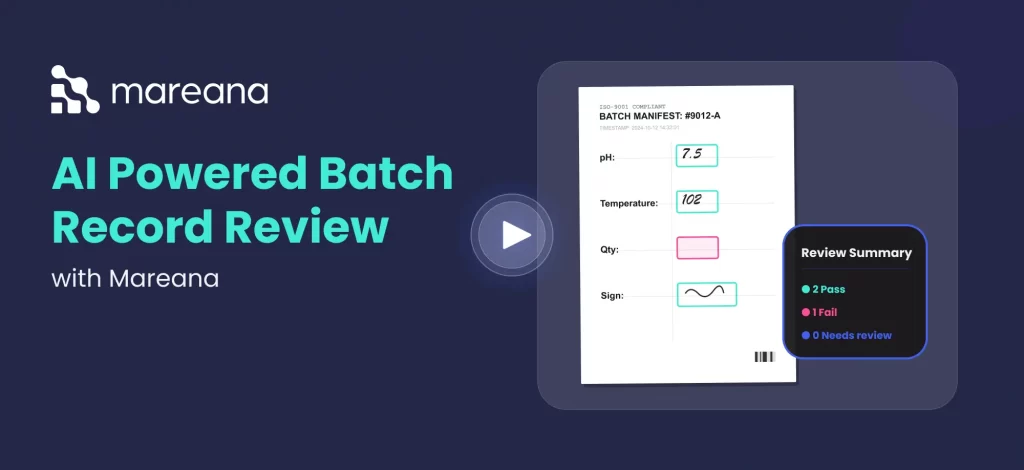
Do you want to upgrade your current batch review setup by adding a layer of AI on top of it? Mareana can do it for you. Contact us to know how.
Frequently Asked Questions (FAQs)
-
Why are traditional batch review tools no longer effective in today’s manufacturing environment?
Traditional systems were built for slower, simpler operations. They can’t handle real-time data, high-frequency sensor feeds, or the cross-system complexity of modern biopharma processes. This results in manual work, delayed reviews, and missed insights.
-
What challenges do manufacturers face when relying on older batch review systems?
Common issues include long review cycles, data silos, manual reconciliation, lack of real-time visibility, increased human error, and growing compliance risks. These factors collectively slow down product release and strain QA teams.
-
How does fragmented data impact batch review efficiency?
When data is spread across MES, LIMS, ERP, QMS, and paper records, QA teams must manually piece together information. This slows release times, increases transcription errors, and complicates investigations.
-
What capabilities should a modern batch review platform include?
A next-generation solution should provide a unified data layer, AI-enabled review-by-exception, automated verification logic, real-time analytics, full traceability, and tools for predictive quality and accelerated investigations.
-
Which software improve batch review compared to traditional software?
Mareana uses AI, contextualized data, and generative analytics to automate the review process, eliminate manual data chasing, and give QA teams full visibility into every aspect of manufacturing. Its Batch Release Copilot and Batch Genealogy features significantly reduce review time and errors.
-
What role does AI play in reducing compliance and quality risks?
AI automates validation, highlights exceptions, detects anomalies early, and builds audit-ready reports. This reduces human error, improves consistency, and strengthens regulatory readiness.
-
Is there a tool to accelerate deviation investigations in pharma manufacturing?
Mareana’s AI chatbot Neptune synthesizes data from across the system’s knowledge graph, enabling teams to find root causes in minutes rather than days. It provides contextual explanations instead of raw, disconnected data points.
-
Can modern tools support real-time or continuous batch release?
Yes. Advanced platforms can ingest high-velocity data, detect anomalies instantly, and deliver continuous verification—something impossible with first-generation EBR systems.
-
What measurable benefits can manufacturers expect from adopting modern batch review intelligence?
Organizations typically see faster batch release cycles, reduced labor costs, fewer deviations, stronger compliance, and improved visibility across the production lifecycle.



 Learn more