Summary
CAPA Management with AI chatbots is transforming how pharmaceutical manufacturers investigate deviations, perform root cause analysis, and manage corrective and preventive actions. Instead of relying on slow, manual investigations across siloed systems, AI-powered chatbots enable quality teams to analyze product genealogy, historical batch records, and operational data through simple natural language queries. This accelerates investigations, reduces CAPA documentation time, and helps organizations shift from reactive problem-solving to predictive quality management.
Solutions like Mareana’s AI-driven platform bring this capability directly into pharmaceutical quality workflows by connecting data across ERP, LIMS, MES, and QMS systems. By combining conversational AI with deep manufacturing data insights, Mareana enables faster deviation triage, evidence-based root cause analysis, and audit-ready compliance—helping manufacturers modernize CAPA Management with AI chatbots while improving operational efficiency and regulatory readiness.
Pharmaceutical manufacturers have long treated Corrective and Preventive Action (CAPA) as a burdensome administrative hurdle. Traditionally, CAPA management is reactive, manual, and siloed, with quality teams spending weeks digging through disparate systems to identify the root cause of a single deviation.
However, the emergence of AI-powered chatbots is transforming this process from a slow-moving documentation exercise into a proactive engine for continuous improvement.
The Big Picture: Where AI Drives Value
The modernization of CAPA is central to a broader industry trend where AI is redefining value across the pharmaceutical lifecycle. According to research by PwC (Strategy&), the impact of AI is distributed across four primary categories:
The impact of AI on the Pharmaceutical Industry
Operations account for the lion’s share (39%) of the impact because they affect the largest cost baselines. This is precisely where AI-driven CAPA management sits—at the intersection of production efficiency and cost reduction. By optimizing CAPA, manufacturers are addressing the single largest lever for operational value.
1. Unlocking the “Batch Family Tree” with Product Genealogy
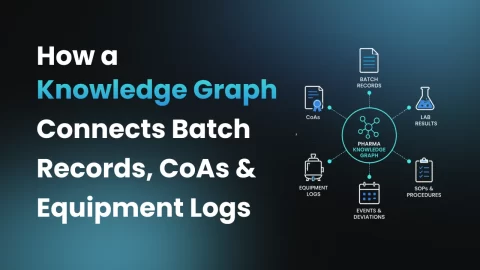
One of the most powerful—yet often missing—elements in traditional CAPA is a unified view of Product Genealogy. In pharma, a single batch has an intricate lineage: it has “parents” (raw materials), “siblings” (other batches made on the same line), and “children” (the distributed products).
Traditionally, mapping this genealogy is a manual nightmare, requiring investigators to bridge data silos between ERP, LIMS, and MES. However, modern platforms are now accelerating product genealogy using AI to automatically map these relationships in hours rather than months.
When a chatbot is layered over this genealogy map, it becomes a “Conversational Historian.” A quality lead can simply ask:
“Show me all batches that used the same raw material lot as Batch #472 and flag any process deviations they shared.”
By instantly traversing the genealogy graph, the chatbot eliminates the manual “data wrangling” that usually stalls investigations.
2. Accelerating Root Cause Analysis (RCA)
Root cause analysis is where most CAPA cycles stall. Human bias often leads investigators to the “easiest” explanation (e.g., “human error”) rather than the systemic issue. AI chatbots improve RCA through:
- Historical Pattern Recognition: Chatbots can analyze thousands of historical records in seconds, flagging similar events and the corrective actions that actually worked in the past.
- Unstructured Data Analysis: Using Natural Language Processing (NLP), chatbots can “read” technician notes and audit comments to find hidden correlations between equipment performance and quality outcomes.
- Evidence-Based Investigation: AI provides the evidence—not just a guess—enabling investigators to reach more defensible conclusions during regulatory audits.
3. Shifting from Reactive to Predictive
The ultimate goal of a modern quality system is to prevent CAPA overload by moving from reactive firefighting to proactive prevention. AI-driven systems are moving toward Predictive Quality:
- Leading Indicators: Chatbots can monitor real-time data streams and alert teams when a combination of factors (e.g., rising equipment vibration + humidity shifts) historically precedes a failure.
- Effectiveness Prediction: Before a CAPA is even implemented, AI can predict the probability of success for a proposed corrective action by comparing it against the outcomes of similar past interventions.
4. GxP Compliance and the “Human-in-the-Loop”
In a GxP (Good Practice) environment, “automation” cannot mean “unsupervised.” The role of the AI chatbot in CAPA management is that of a Co-Pilot, not a pilot.
- Drafting, Not Deciding: The AI can draft the deviation narrative and propose the CAPA plan, but a human quality reviewer must validate and sign off on every entry.
- Audit-Ready Traceability: Every interaction with the chatbot is logged, creating a clear audit trail. This transparency is a “gold mine” for inspectors who want to see that the company has a deep, data-driven grip on its processes.
Regulatory Alignment: The Shift Toward “Good AI Practice”
The transition from manual to AI-enhanced quality is now a formal regulatory expectation, transcending its role as a mere operational choice. The FDA and EMA recently released joint guiding principles for AI in drug development, signaling a move toward “Good AI Practice.”
For QA professionals, this means AI is no longer a “black box.” It requires traceable data provenance, continuous monitoring for data drift, and risk-based assessments—all of which are naturally facilitated by a GxP-by-design chatbot interface that maintains high visibility into how data is processed and used.
Conclusion: The Business Impact
Organizations integrating AI chatbots into their quality workflows are seeing significant operational gains:
- 70% reduction in batch record review time.
- 40–60% less time spent on CAPA documentation.
- 15–30% faster triage of deviations.
These efficiencies are more than just administrative wins. According to research by PwC (Strategy&), pharmaceutical companies that fully industrialize AI use cases across their organizations have the potential to double today’s operating profits.
By leveraging tools that understand the deep genealogy of their products, quality professionals can finally move beyond the “red tape” and focus on process optimization.
The Business Impact of AI-Driven CAPA
Batch record review time
Spent on CAPA documentation
Triage of process deviations
What’s Next?
Moving from manual documentation to an AI-enhanced quality environment is a significant transition for QA and QC professionals. If you are looking to implement a chatbot to streamline your CAPA management, we can help you navigate the process.
Our Neptune chatbot allows you to explore your manufacturing data using natural language. You can ask questions, surface insights, investigate deviations, and even generate charts instantly. It functions as a data scientist, historian, and process expert, all within a single conversational interface.
Contact us to see how Neptune can help you move from manual oversight to proactive, compliant quality management.



 Learn more