Summary
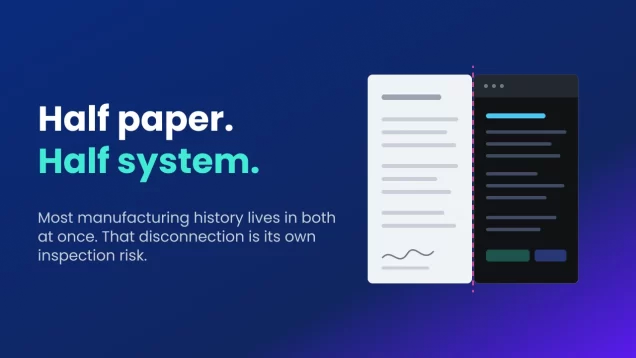
Most manufacturers keep a batch’s history across paper binders, laboratory systems, manufacturing execution systems and shared drives. Each part is accurate. Nothing connects them.
This blog covers what the record gap data actually shows, why an electronic quality management system does not resolve it, and why paper is not the thing to blame.
Paper is not the problem, and neither is a mix of paper and electronic. The problem is disconnection: records that are individually accurate and collectively unable to answer a single question. That is a record-architecture problem, and it is solvable without replacing what you already have.
Mareana connects manufacturing history across paper batch records, laboratory systems, manufacturing execution systems and enterprise sources into one queryable lineage, so the answer to how a batch was made exists as a connected whole before anyone asks for it.
Most pharmaceutical manufacturers keep a batch’s history in more than one place. Some of them sit in paper batch records, some in a laboratory system, some in a manufacturing execution system, and some on a shared drive. Using both paper and electronic records is not by itself, the problem.
The problem is what happens when those records are not connected.
Each source may be accurate on its own, but if there is no connected lineage between them, QA has to reconstruct the batch history every time someone asks a question. Materials and their lots may sit in one place, processing parameters in another, deviations somewhere else, and laboratory results and signatures in yet more systems.
Then an inspector asks the question that ultimately matters: “Show me how this lot was made.”
Answering it means finding the right records, connecting them, validating that they belong to the same batch, and assembling the complete story while someone is waiting. That reconstruction is the real inspection risk.
The solution is not to eliminate paper or force every record into a single system. It is to make the records you already have connected, traceable, and retrievable, so the complete history of a batch can be produced without rebuilding it from scratch.
What an inspector is asking when they say “show me how this was made”
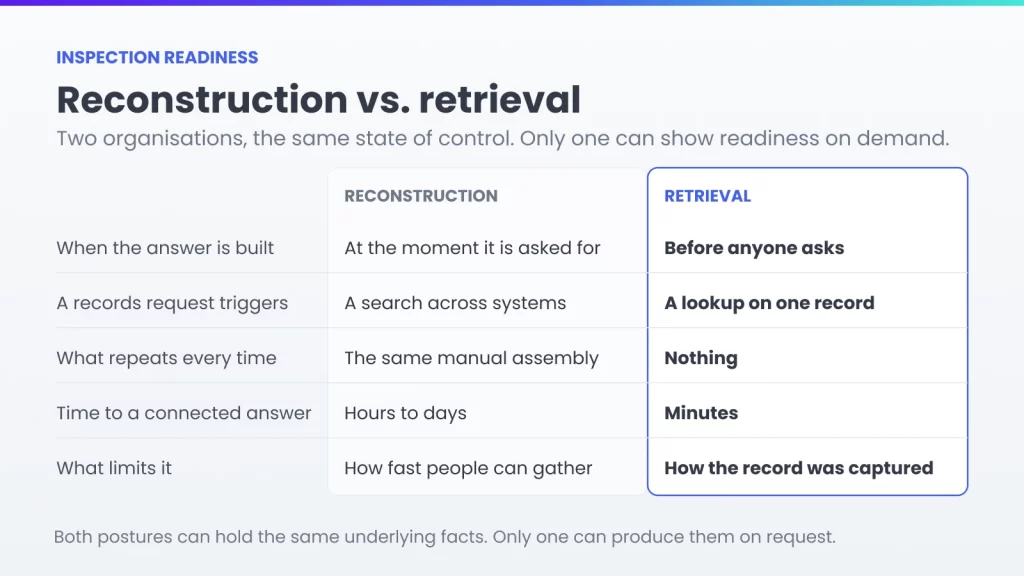
The inspector is looking for a connected story and there are two ways to produce it. Either retrieve it or reconstruct it.
In some organizations, the answer is retrieved. A person follows the lineage of that lot across its history, from incoming material through every unit operation to release, and presents it whole. It came out whole because it was already whole.
In others, the answer is reconstructed. People fan out to shared drives, laboratory systems, and archived binders, then assemble the story by hand while the clock runs. The work is skilled and the people doing it are usually excellent. It is still assembly, performed live, under observation.
Both organizations may hold the same state of control. The manufacturing may have been equally sound. Only one of them can show it on demand.
These models aren’t defined by company size. They depend on how the record system is set up and how those records are used.
What the record-gap data shows
Inspections rarely fail on the science. They fail on the record. Look at what findings actually cite and the pattern is clear: the problems are procedural and documentary far more often than technical.
Across FDA warning letters, one of the most frequently cited regulations is [21 CFR 211.100(a)](Pharmaceutical Online, “Trends in FDA FY 2025 Warning Letters,” Eliquent Life Sciences), which covers production and process controls not supported by written procedures. Quality-unit citations under 21 CFR 211.22(a) and 211.22(d) appear regularly alongside it. Neither finding is about whether a molecule works. Both are about whether an organization can show, on paper, that it did what it said it would do.
A peer-reviewed analysis of fifteen years of biologics Form 483 observations, published by Dhanabal and colleagues in the Journal of Pharmaceutical Innovation in 2026, found that the leading causes were failure to follow standard operating procedures at 34%, failure to maintain contemporaneous documentation at 21%, and inadequate investigation before batch release at 14%.
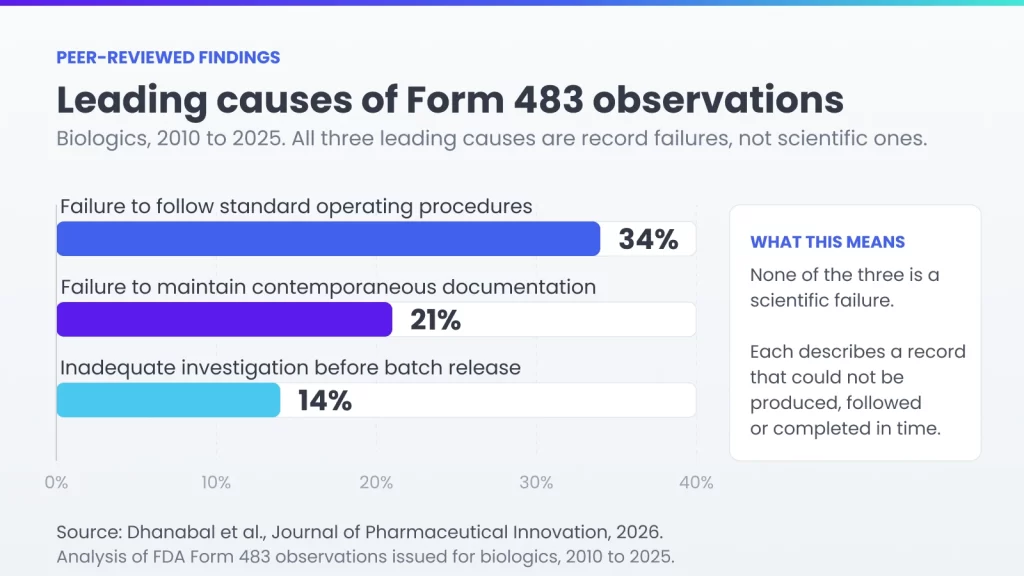
An old refrain in every quality unit explains why. If it isn’t documented, it didn’t happen. To an inspector, the record is not a description of reality. It is the reality. A batch may have been made flawlessly, but if the story of how cannot be produced, connected and complete, then the state of control cannot be demonstrated. What cannot be demonstrated is treated as absent.
If the record is the reality, then the condition of the record system is the condition of the organization. Most organizations sit in a condition that has a name.
What the disconnected record state is
The disconnected record state is the condition in which an organization’s manufacturing history is split across paper binders, shared drives, laboratory information management systems, manufacturing execution systems, and an electronic quality management system, with no single connected source of truth linking them.
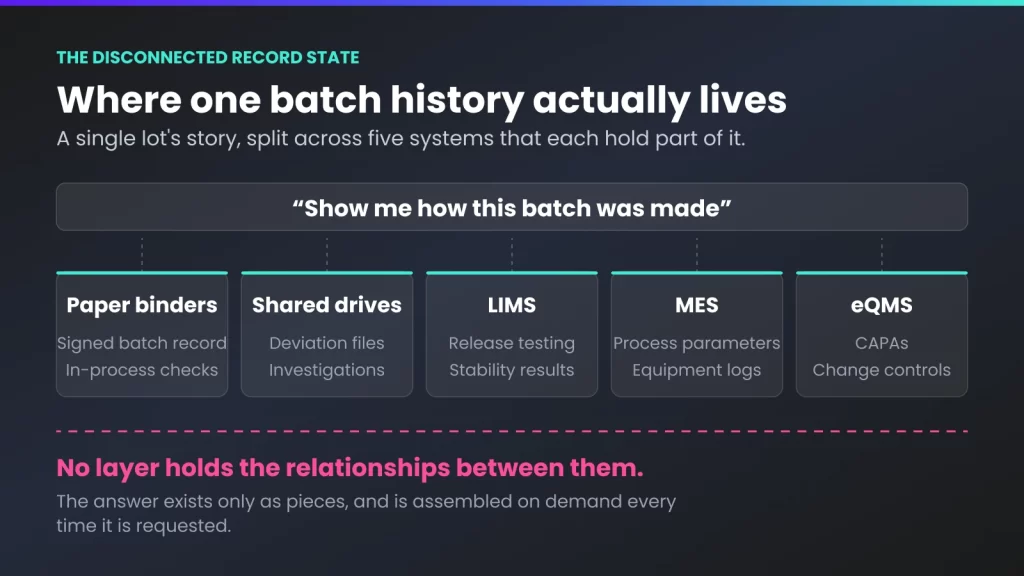
In this state, the answer to how a product was made has no home. It exists only as pieces, and the whole has to be assembled every time someone asks. The pieces are not missing. They are present, complete, and disconnected, which is a harder problem to see, because nothing appears to be wrong until someone asks a question that spans them. Most organizations live here. It is the normal condition of the industry, not an edge case.
Organizations consistently underestimate two things: how long they will live in the seam between paper and electronic, and how much inspection exposure accumulates while they are there. A transition scoped in months routinely runs into years, and the record spans both regimes throughout.
Naming it as a standing risk changes how it gets managed and how it gets funded. A condition with no name is nobody’s line item. A named risk category has an owner, a review cadence, and a place in the risk register, which is roughly the difference between a problem that gets worked and a problem that gets absorbed. A problem that gets absorbed tends to surface at the least convenient hour.
Here the obvious objection arrives, and it deserves a direct answer. We bought an eQMS.
Why an eQMS doesn’t resolve it
Having an electronic quality management system does not resolve the disconnected state. It is a reasonable thing to expect it would, and it is one of the more expensive assumptions in the industry.
Disconnected environments persist regardless of software spend, because the systems were never designed to hand one connected lineage to a single query. An eQMS is authoritative for quality events. A laboratory system is authoritative for results. A manufacturing execution system is authoritative for what happened on the floor. Each does its job well, and none of them owns the relationships between them, which is precisely what a batch’s story consists of.
A system also does not fix a weak process. Digitizing a record is not the same as connecting it, and connecting it is not the same as being ready. Organizations with substantial technology investment still find themselves assembling answers by hand, which is worth sitting with before the next platform decision. None of which means paper is the villain here.
Paper isn’t the problem. Retrieval is.
Paper is not inherently non-compliant. Records kept on paper can fully satisfy ALCOA+. However, a compliant record that takes an afternoon to assemble across three systems and a binder is a very different inspection exposure from the same record held as a connected whole. State of control is worth defining precisely here: it is the demonstrable condition of a process being operated within established parameters, with the evidence available to show it.
Two of the nine attributes carry most of the weight in a scattered system, and this is a practitioner’s reading rather than a regulatory interpretation. Complete and available are where a compliant-but-scattered record starts to strain. Each piece is accurate. Assembled at speed, under observation, the set is neither reliably complete nor reliably available. That strain gets sharper when the records were never yours to begin with.
What this looks like when the records live in someone else’s building
Virtual and asset-light sponsors carry the starkest version of this. They hold full Marketing Authorisation Holder and sponsor accountability, meaning the regulatory responsibility for the product sits with them, and they own neither the site, nor the data, nor the staff being inspected.
Practitioners report that these firms frequently receive scanned-PDF batch records that have to be manually re-keyed, though no independently sourced quantification of that practice exists in public data. The answer to how a product was made lives in someone else’s building, in a format the sponsor cannot directly interrogate. It has to be requested, received, and reassembled before it can be shown to anyone.
This is one of four recognizable versions of the same root problem, alongside integrated multi-site networks, hybrid manufacturers mid-transition, and contract organizations. Accountability, meanwhile, does not transfer with the manufacturing: FDA’s November 2016 guidance on contract manufacturing arrangements and ICH Q10 both place ultimate responsibility for product quality on the application owner, regardless of how much is delegated.
Whitepaper
Four failure modes, one root cause
The other three versions of this problem, and the accountability question sitting underneath all four, are mapped in our whitepaper Show Me How This Was Made. It compares virtual sponsors, integrated networks, hybrid manufacturers, and contract organizations against the same root cause, and it puts a number on what facility and record unreadiness costs in approval time.
Read the whitepaper


 Learn more