Summary
Virtual pharma sponsors are facing mounting compliance pressure, tighter timelines, and outdated paper-based CDMO data systems that no longer support modern regulatory demands. Traditional solutions such as EDMS, sponsor portals, and mandated MES adoption fail because they either lock data in static formats, create operational resistance from CDMOs, or require unrealistic control over external manufacturing partners. The core challenge lies in a structural constraint: CDMOs cannot adapt to each sponsor’s systems, leaving sponsors with fragmented, unstructured, and non-actionable data.
A sponsor-side Manufacturing Intelligence Platform (MIP) offers a scalable solution by converting unstructured CDMO records into structured, analyzable data using AI-OCR, knowledge graphs, and exception-based review workflows. This approach enables real-time insights, automated validation, and audit-ready compliance—without requiring any changes to CDMO operations. For effective implementation, sponsors should prioritize CDMO-agnostic ingestion, compliance with 21 CFR Part 11 and EU GMP Annex 11, and intelligent review-by-exception capabilities to reduce manual effort and focus on critical quality risks.
As we examined in a recent blog Why Paper-Based CDMO Batch Records Are Now a Compliance Crisis, virtual pharma sponsors now face a convergence of escalating regulatory enforcement, compressed product timelines, and a paper-based data infrastructure built for a slower era. The question that analysis left unanswered: what can sponsors actually do about it?
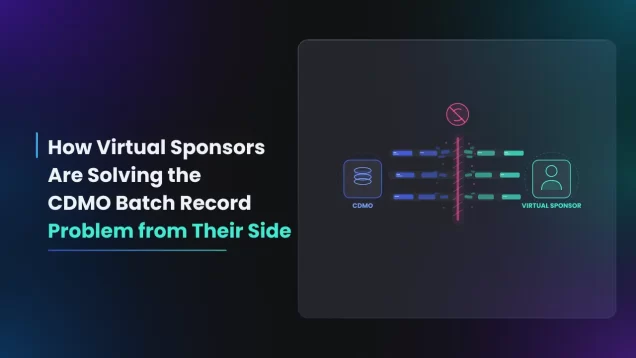
Every solution attempt confronts the same structural constraint. CDMOs serve dozens of clients simultaneously and have no economic incentive to adopt any single sponsor’s preferred system or data format. Their margins do not support bespoke integrations for individual sponsors. Any viable approach must therefore operate entirely from the sponsor’s side, ingesting whatever format the CDMO produces without requiring a single change on the manufacturing floor. This constraint is the reason why every conventional solution has failed. Before examining what works, it helps to understand why the approaches most sponsors have tried don’t.
Why the Obvious Solutions Don’t Work for Virtual Pharma
Most virtual sponsors begin with an Electronic Document Management System (EDMS). CDMOs scan their paper batch records into PDFs, transmit them to the sponsor, and the EDMS routes them for review and approval. The logic is sound; the limitation is fundamental. The document is stored, but the data inside it stays dark: inaccessible to queries, trend analysis, or automated validation. Quality teams gain an organized filing cabinet but remain trapped in the same manual cycle. Every parameter must still be manually extracted through the same error-prone swivel-chair process that generates documentary deviations. The compliance risk and FTE burden persist unchanged.
A second approach pushes digitization upstream through sponsor-specific web portals where CDMOs enter data directly into the sponsor’s system. In theory, this eliminates the PDF bottleneck. In practice, CDMOs resist, and for defensible reasons. CDMOs operate on tight margins and serve dozens of clients simultaneously. Asking CDMO operators to learn and maintain 50 different sponsor-specific portals introduces unacceptable operational risk on the manufacturing floor. The approach shifts the transcription burden to the vendor without eliminating it, and fractures the sponsor-manufacturer relationship in the process. Compliance responsibility still rests with the sponsor, but the data entry now happens outside the sponsor’s direct observation.
A third path, frequently proposed by consultants and enterprise software vendors, involves mandating that CDMOs deploy a fully integrated Manufacturing Execution System (MES) or electronic batch record platform. For integrated manufacturers with their own facilities, this can work. For asset-light biotechs with revenues under $250 million, it is a mirage. Virtual sponsors lack the capital leverage to dictate IT infrastructure to a CDMO whose facility serves dozens of other clients with competing digital requirements. The timeline for universal CDMO adoption of electronic batch records is measured in years, not months, and virtual sponsors working with multiple CDMOs at varying digital maturity levels cannot wait for the lowest common denominator to catch up. Even where a CDMO has invested in electronic batch records, the resulting exports are often non-standard and still require sponsor-side normalization before they can support meaningful quality review.
What emerges from this evaluation is a clear architectural requirement. The solution must operate from the sponsor’s side, ingesting whatever format the CDMO produces without requiring any change to shop-floor workflows. That requirement points toward a different category of platform entirely.
The Sponsor-Side Intelligence Approach
A Manufacturing Intelligence Platform (MIP) occupies an entirely distinct category from either an EDMS or an MES. Where an EDMS stores static files and an MES controls the shop floor, a MIP is a cloud-based platform that ingests structured and unstructured manufacturing data, contextualizes it using AI and graph-based algorithms, and presents it in a unified, query-ready environment. An EDMS stores the document; a Manufacturing Intelligence Platform transforms unstructured CDMO documents into structured, analyzable data. A MIP operates at the sponsor level, decoupling data intelligence from data generation. This distinction matters: virtual sponsors need intelligence about their manufacturing data, not control over the systems that generate it.
Sponsor-side intelligence rests on three layers, each addressing a specific failure point in the traditional workflow. The first layer uses pharma-specific AI-OCR to ingest scanned, handwritten CDMO batch records and Certificates of Analysis. Unlike generic optical character recognition, these specialized models are trained on pharmaceutical vocabulary, document layouts, and handwriting patterns unique to the domain. Critically, the system is CDMO-agnostic: it processes whatever document format the manufacturing partner produces without requiring any upstream changes to how those records are created or transmitted.
In the second layer, extracted data gains its manufacturing context through knowledge-graph algorithms. Extracted values are automatically standardized and linked to the correct batch, unit-operation, and material lot without requiring manual master-data preparation or complex ETL scripting. Records become traceable nodes in a batch genealogy. For sponsors working with multiple CDMOs at varying levels of digital maturity, this contextualization layer transforms fragmented inputs from disparate sources into a unified, query-ready lineage that supports continuous process verification, trend analysis, and regulatory compliance.
At the third layer, the model operationalizes what practitioners call review by exception: quality personnel evaluate only data points that violate predefined parameters, rather than reading every page of every record. A configurable rule engine applies hundreds of pharma-specific checks across ranges, calculations, signatures, and open deviations. Compliant parameters are confirmed automatically; human expertise concentrates on genuine anomalies rather than routine confirmation. For the detailed technical architecture of each layer, including confidence scoring, graph-based contextualization, and configurable rule engines, download the full analysis [Whitepaper: Oversight Without Control].
Together, these three layers form a complete operational model: AI-powered extraction converts dark data into structured fields; knowledge-graph contextualization links those fields to their manufacturing context; and exception-based review ensures that quality personnel focus on what matters. The virtual sponsor achieves auditable oversight of CDMO manufacturing data without requiring the CDMO to alter a single workflow on the production floor.
What to Look for in a Solution
Understanding the model is the first step. Evaluating specific platforms requires a different lens. Three criteria should be non-negotiable in any vendor conversation.
First, CDMO-agnostic ingestion capability. The platform must accept any document format from any manufacturing partner without requiring the CDMO to adopt new systems or workflows. If the solution depends on CDMO cooperation, it will fail for the same structural reasons that web portals fail. Virtual sponsors work with multiple CDMOs at varying stages of digital maturity; the platform must accommodate all of them from day one. In practice, this means the system should handle handwritten paper records, scanned PDFs, and non-standard electronic exports from different CDMOs with equal reliability, regardless of layout conventions, abbreviation standards, or document structure.
Second, 21 CFR Part 11 and EU GMP Annex 11 validation readiness. Every extracted data point and every reviewer action must be captured in a tamper-evident audit trail with electronic signatures and role-based access controls. Validation documentation should be available at deployment, not promised as a future deliverable. Ask to review the validation package during the evaluation process, not after the contract is signed.
Third, exception-based review workflow with configurable rules, confidence scoring, and role-based routing. Quality personnel should focus their expertise on genuine anomalies rather than re-reading compliant data page by page. The platform should clearly distinguish between critical failures, warnings, and confirmed parameters, so reviewers can prioritize their attention where it has the greatest impact on product quality and patient safety. Without this capability, the platform simply accelerates the delivery of data that still requires exhaustive manual review.
Vendor Selection Framework
Three Criteria for Selecting a
Manufacturing Intelligence Platform Vendor
These three criteria are essential starting points. The complete five-criteria evaluation framework, with detailed compliance rationale and weighting guidance for different therapeutic modalities, is available in the full strategic analysis.
This post outlines the approach and three essential evaluation criteria. The full strategic paper goes further: it delivers the technical architecture of each intelligence layer, the complete five-criteria evaluation framework with compliance rationale, and the outcome benchmarks you need to evaluate solutions and build an internal business case. Whether you are presenting to your CFO or briefing your regulatory affairs team, the analysis provides the evidence base for both conversations. Download the full analysis – Whitepaper: Oversight Without Control.



 Learn more