Summary
Smart manufacturing in pharma is usually presented as a technology story about connected plants, sensors, and predictive analytics. For the people who sign a batch disposition, the test is narrower. A smart plant is one where the data supporting a release decision is complete, attributable, and retrievable at the moment the decision is made. That standard became more specific in 2026. Three EU GMP documents covering documentation, computerised systems, and artificial intelligence went to consultation together on 7 July 2025 and are expected to be adopted during the year, while PIC/S PI 006-4 on qualification and validation takes effect on 1 October 2026.
This article sets out what those changes mean for batch release specifically: the expanded audit trail expectations in the revised Annex 11, including the requirement to capture data creation events and link trails to batch records; the line draft Annex 22 draws around AI in GMP-critical applications, where only static, deterministic models are permitted and generative AI and large language models are excluded; where review by exception produces real cycle time gains without reducing oversight; and why batch disposition remains non-delegable for sponsors whose product is made at a CDMO. It closes with six preparation steps QA and compliance leaders can sequence before the fourth quarter.
What Smart Manufacturing in Pharma Means for a Release Decision
Smart manufacturing in pharma is the use of connected systems, real-time process data, and automated analysis to make manufacturing decisions from evidence rather than reconstruction after the fact. A smart plant is one where the data supporting a batch disposition is complete, attributable, and retrievable at the moment the decision is made. A digital twin does not sign a batch record. A Qualified Person does.
Quality testing and batch release account for upwards of 70% of total manufacturing lead time, and the cause is rarely the science. It is manual reconciliation, disconnected instruments, and documentation nobody can query. Smart manufacturing in pharma is usually sold as a technology story about sensors, digital twins, and connected plants. For the person who signs the disposition, it is narrower: can this batch be released faster without weakening the evidence behind the decision.
That question got sharper in 2026. Three EU GMP documents governing documentation, computerised systems, and artificial intelligence are moving toward adoption this year, and a new PIC/S qualification and validation guide takes effect on 1 October 2026. Here is what changed, what it means for batch release, and what to have in motion before the fourth quarter.
The 2026 Regulatory Reset: Chapter 4, Annex 11, and Annex 22
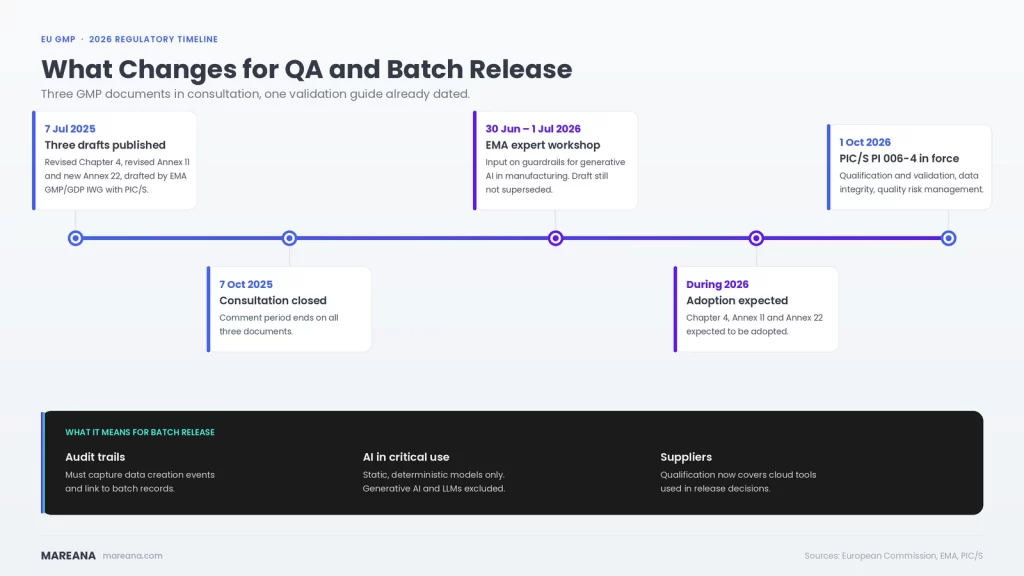
On 7 July 2025 the European Commission published three linked drafts for consultation: a revised Chapter 4 on documentation, a revised Annex 11 on computerised systems, and an entirely new Annex 22 on artificial intelligence, drafted jointly by the EMA GMP/GDP Inspectors Working Group and PIC/S. Consultation closed on 7 October 2025 and adoption is expected during 2026.
The scale of the Annex 11 revision signals the direction. It grew from roughly 5 pages to 19 across 17 sections, the first full rewrite since 2011. Three changes land directly on GxP batch release:
- Audit trails must capture data creation events, not only changes and deletions. A logged reading is itself traceable.
- Audit trail management carries defined review frequency, immutability expectations, and explicit linkage to batch records.
- System providers must be qualified and audited, with contracts defining version control and exit strategies.
That third point is the one hybrid operations tend to miss. A cloud analytics tool used in release decisions now sits inside supplier qualification scope. A second deadline follows: PIC/S PI 006-4 takes effect on 1 October 2026.
Annex 22 Draws a Hard Line Around AI in Critical Decisions
Annex 22 is the first EU GMP guidance written specifically for artificial intelligence. It applies to AI models embedded in computerised systems used in manufacturing, but only in critical applications that directly affect patient safety, product quality, or data integrity. The exclusions matter more than the permissions.
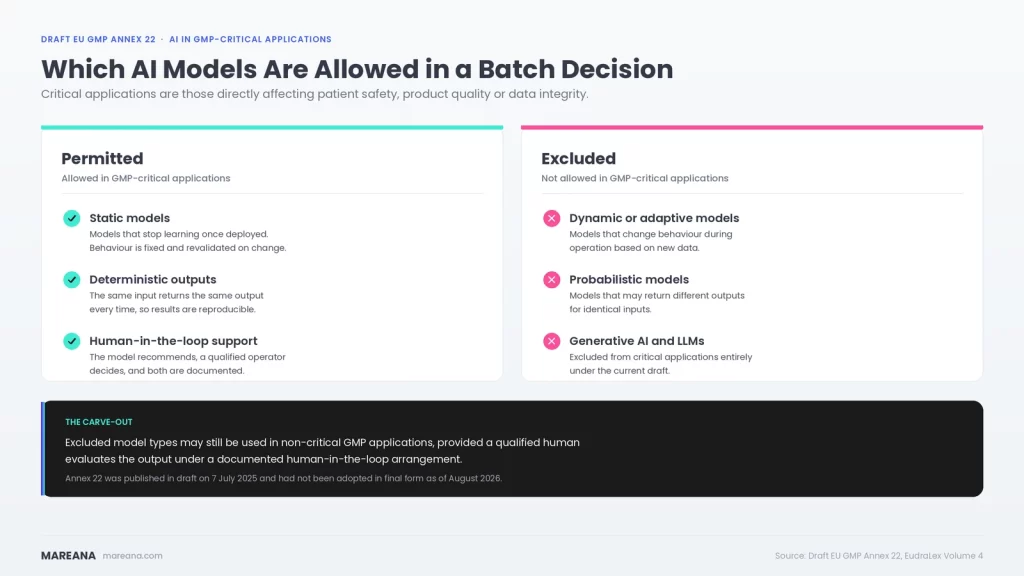
The draft permits only static, deterministic models, meaning models that stop learning after deployment and return the same output for the same input. Excluded from critical applications: dynamic or adaptive models, probabilistic models, and generative AI and large language models. Those may still be used in non-critical GMP applications where a qualified human evaluates the output.
For models used in critical applications, the draft sets requirements most pilots have never faced:
- Intended use documented and approved by a process SME before acceptance testing
- Performance equal to or better than the process being replaced
- Test data independent of training data, with developers barred from access, or a four-eyes principle where segregation is not feasible
- Explainable outputs, with influential features recorded and reviewed by SMEs for scientific relevance
- Confidence scores logged with decisions, and thresholds escalating low-confidence outputs to manual review
- Input data monitored for drift outside the validated sample space
The equal-or-better requirement deserves attention. No site can adopt an AI-assisted review workflow without first measuring how well its manual review performs, and most have never quantified that. It becomes the first piece of work rather than the last.
Annex 22 is still moving. EMA held a workshop on 30 June and 1 July 2026 on guardrails for generative AI in manufacturing, and as of August 2026 no final version had replaced the July 2025 draft.
In the US, FDA’s January 2025 draft guidance applies a seven-step credibility framework, and FDA and EMA jointly published Guiding Principles of Good AI Practice in Drug Development in January 2026.
Why Batch Release Is Where Smart Manufacturing in Pharma Pays Off First
Batch release sits at the end of the value chain, where delay converts directly into working capital and service level impact. BioPharma International reports average review time for a single batch report at around 48 hours, with some manufacturers describing a full review consuming up to 500 hours and right-first-time production as low as 47%. The mechanism that changes those numbers is review by exception.
Nothing is skipped. Every value is still captured, validated, and retained.
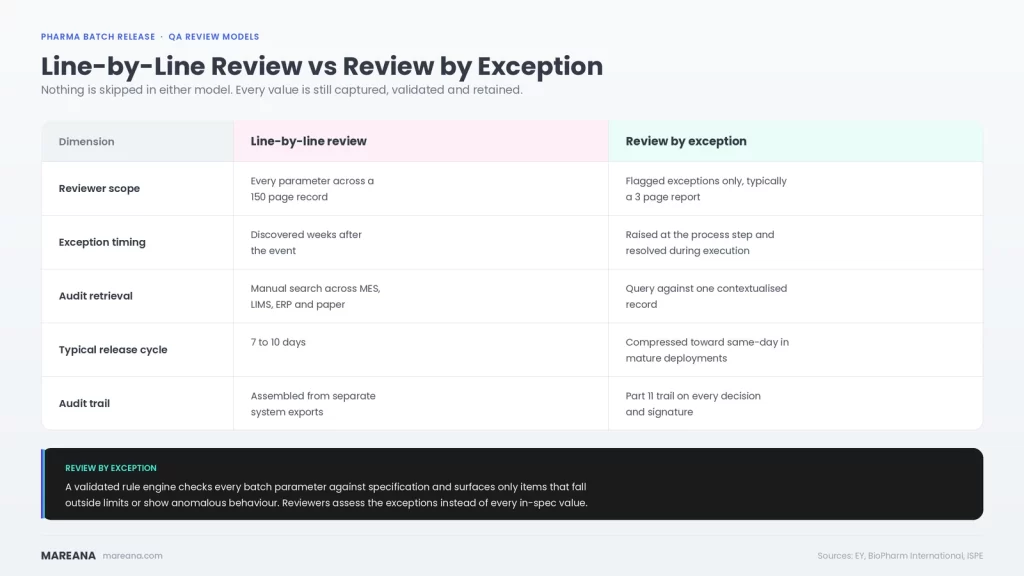
Teams using Mareana’s exception-based batch review have reduced cycle times by up to 70%.
Releasing Batches You Did Not Manufacture
Sponsors that outsource manufacturing carry the full regulatory weight of the release decision for product made on someone else’s floor. Batch disposition is non-delegable under FDA’s 2016 guidance on contract manufacturing arrangements. A quality agreement allocates work. It does not transfer accountability.
Consider the inspection version. An investigator asks how a parameter trended across the last twelve lots and whether the deviation on lot 47291 recurred. The answer exists, spread across a CDMO system export, three PDF batch records in a shared drive, and a deviation log in the sponsor’s QMS. Assembling it takes days. The investigator is in the room now.
Every requirement above lands harder here. Audit trail review before release is difficult when the audit trail belongs to another company, and Annex 11 supplier qualification now extends to the systems your CDMO uses to generate your evidence. Sponsors need those records in queryable form before any analysis layer is worth building, which is why paper batch record digitization comes first.
What to Have in Motion Before October
- Refresh the GxP system inventory, including cloud services and interfaces, with a criticality assessment for each.
- Run a gap analysis against the drafts, prioritising audit trails, access management, and security.
- Baseline current review performance. Annex 22 makes this a prerequisite for AI adoption, and it is useful regardless.
- Classify every AI use case as critical or non-critical. Anything touching disposition, specification conformance, or data integrity is in scope.
- Review supplier contracts for audit rights, version control, data access, and exit strategies.
- Prepare for PIC/S PI 006-4 ahead of 1 October 2026.
None of this requires a platform decision. All of it makes the eventual platform decision cheaper and easier to defend.
Conclusion
The 2026 package does not slow smart manufacturing down. It defines the evidence standard digital release workflows must meet, which is more useful than ambiguity. Sites already running exception-based review with a complete audit trail will find the gap analysis confirms what they do. Sites running hybrid processes across four systems will find the gap analysis is the project.
The practical question for the rest of this year is narrow. When an investigator asks how a batch was released and what evidence supported it, how long does it take to answer, and does the answer hold together.
Mareana works with quality teams building that capability on connected manufacturing data. Contact our team to discuss batch release readiness for 2026.



 Learn more