Summary
This blog explains why Review by Exception (RbE) is becoming critical in pharmaceutical manufacturing and why enterprise MES is not the only path to achieving it. While many pharma companies still rely on manual batch review, growing regulatory pressure and operational inefficiencies are pushing manufacturers toward more automated, data-driven quality processes.
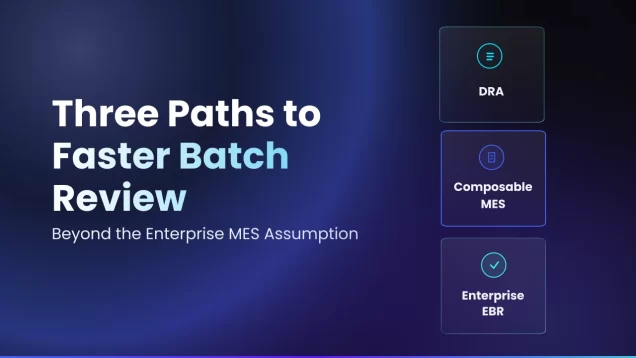
The article outlines three practical architectures for implementing RbE based on organizational maturity and operating model:
1. Document Review Automation (DRA) for paper-based operations and virtual pharma companies
2. Composable MES for mid-maturity manufacturers and CDMOs
3. Enterprise EBR/MES for fully integrated, large-scale manufacturers
It also explains the key criteria manufacturers should use when evaluating batch release solutions, including pharma-specific data extraction, contextualized manufacturing data, and configurable exception logic. The core message: successful digital transformation depends on choosing the architecture that matches your operational reality, not following a one-size-fits-all approach.
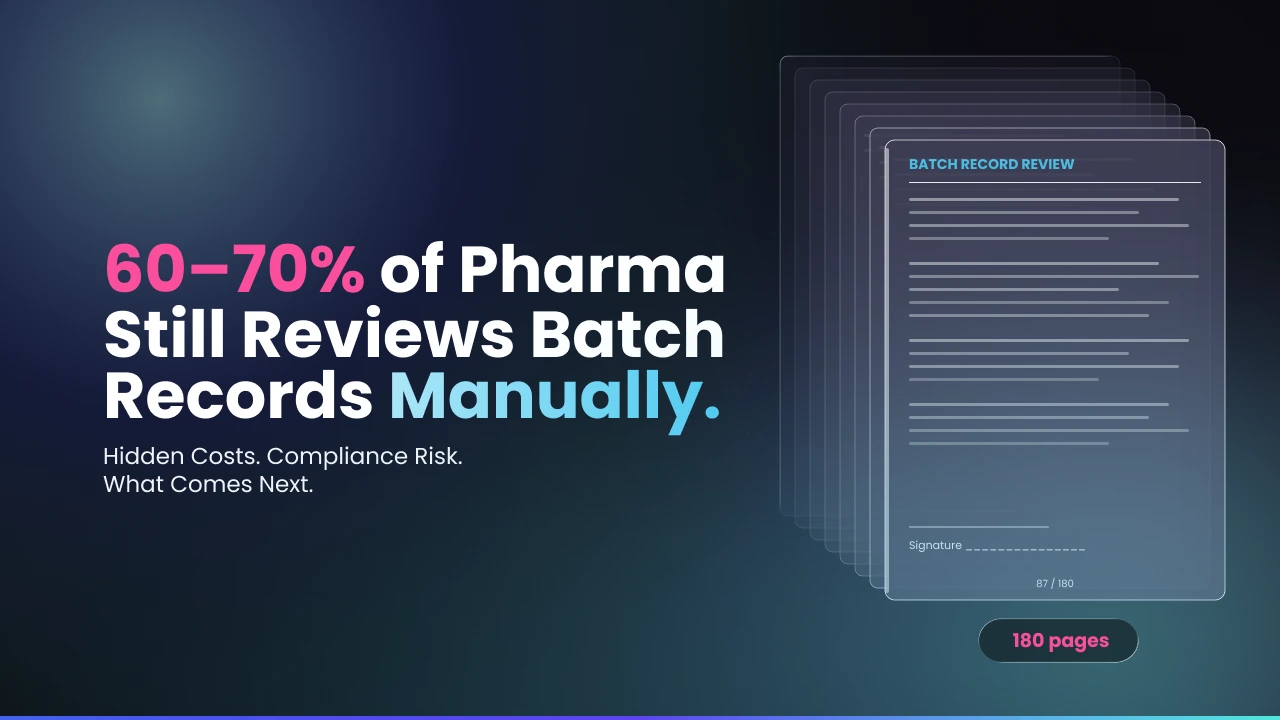
In pharmaceutical manufacturing, 60 to 70 percent of producers are still relying on manual or static-digital batch review. Regulatory pressure to change course is intensifying. We recently examined the operational and regulatory forces making that status quo untenable. Here, we turn to the architectural response.
Review by Exception is not a new methodology. The problem is that the industry has converged on a single answer for how to achieve it: the enterprise Manufacturing Execution System. That single-answer assumption leaves the majority of the market without a viable starting point.
The result is a market shaped by a false binary. Manufacturers without the capital or timeline for full-stack MES deployment have been told, implicitly, that Review by Exception is not for them. This post argues the opposite. It outlines what each archetype can actually deploy.
Three distinct digital architectures can deliver Review by Exception. Understanding which one fits your organization starts with challenging the assumption that has kept most of the industry stuck.
The One-Size-Fits-All Myth
Enterprise Electronic Batch Records (EBR), substitutive systems that eliminate the paper Master Batch Record entirely and govern every aspect of shop-floor execution, represent a genuine achievement in pharmaceutical data governance. At full deployment, they enforce SOPs natively, capture data directly from integrated equipment, apply hard-stop controls when operators attempt out-of-bounds actions, and make automated exception review structurally possible in a way that paper never could. For fully integrated, high-volume manufacturers with the capital and timeline to deploy them, enterprise EBR is the right answer.
The barrier is structural, not aspirational. Enterprise EBR implementations typically require 18 to 24 months and costs frequently exceeding two million dollars for mid-market facilities. That investment profile is not a barrier for large integrated producers. For everyone else, it effectively forecloses the option.
Virtual pharmaceutical sponsors face a different structural impossibility. They bear ultimate regulatory liability for every batch released under their name. Yet they possess zero operational control over the manufacturing floor. Their products are made at CDMOs, frequently across multiple sites and multiple contract partners. Installing an enterprise MES at a contract manufacturer’s facility is not a viable option: it requires the CDMO to operate a sponsor-specific system alongside dozens of other client relationships, creating intellectual property and security concerns that CDMOs are structurally unwilling to accept. The sponsor cannot mandate a system the CDMO will not run.
Sixty to seventy percent of the market cannot deploy enterprise MES in the near term. An industry narrative that treats enterprise EBR as the only legitimate answer has left these organizations without a credible pathway to Review by Exception. That narrative is wrong.
Three Architectures for Review by Exception
Review by Exception is a capability achievable through three distinct digital architectures, each designed for a different organizational maturity level and operating model. The right starting point depends on where your organization operates today, not on where vendor marketing assumes you are.
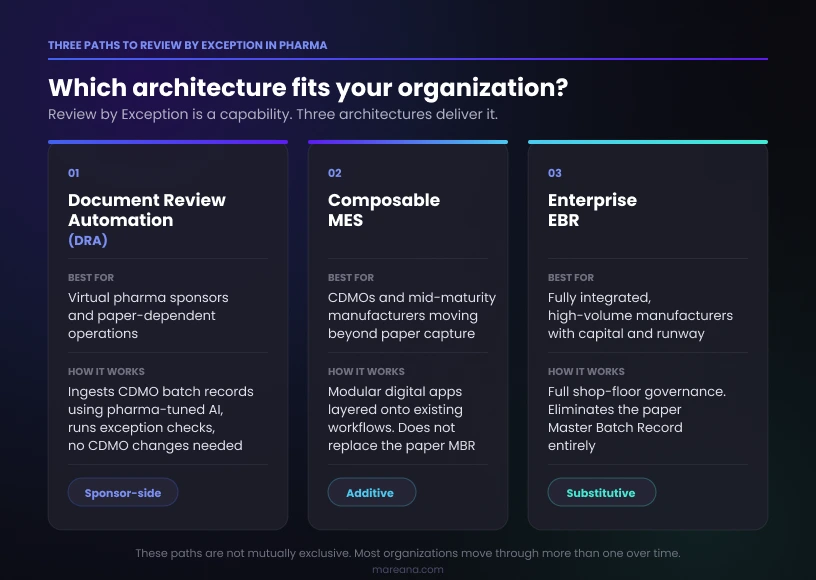
Document Review Automation (DRA) is the pathway for paper-dependent operations and virtual pharmaceutical sponsors. DRA platforms use pharmaceutical-tuned AI models, not generic OCR, to ingest unstructured paper or PDF batch records, automatically extract and classify critical data values, and run algorithmic exception checks against predefined parameters. Because DRA operates sponsor-side, it delivers structured, queryable data and automated exception review without requiring any changes to the CDMO’s systems. The CDMO continues to send records in its current format; the sponsor’s DRA system transforms them into relational, auditable data.
Composable MES is the pathway for mid-maturity operations: CDMOs managing high-mix, multi-client production and mid-market manufacturers moving beyond paper-based data capture. Composable MES platforms are cloud-native, modular systems that let process engineers build individual digital applications (electronic logbooks, dynamic work instructions, weigh-and-dispense modules) and layer them onto existing workflows. Critically, composable MES is additive: it supplements rather than replaces the paper Master Batch Record.
Enterprise EBR, as described above, remains the target architecture for fully integrated manufacturers with the capital and timeline for complete deployment. It is the most capable pathway and also the most demanding: substituting the paper MBR entirely and requiring validated governance of the full production process.
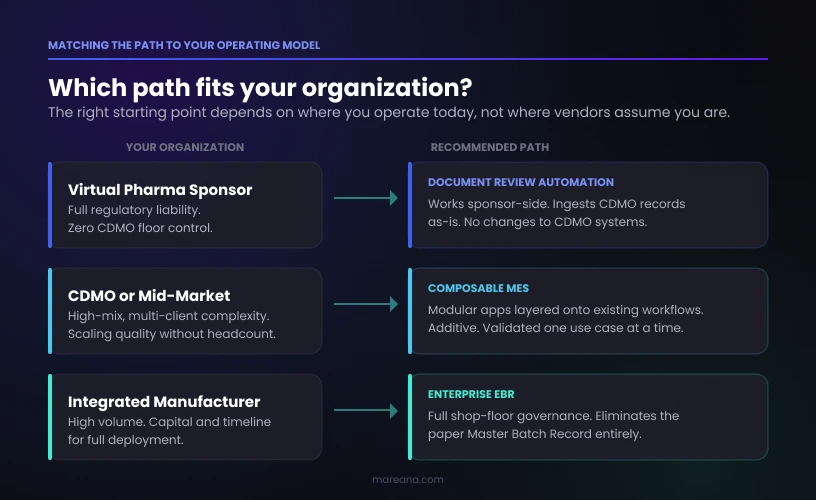
These pathways are not mutually exclusive. A virtual pharma sponsor may begin with DRA for immediate CDMO visibility, then advocate for composable MES adoption at key manufacturing partners as the relationship matures. An integrated manufacturer may deploy composable applications for specific high-risk workflows while maintaining legacy systems on core production lines. The framework is a starting point, not a fixed taxonomy.
One boundary worth establishing clearly: Review by Exception and Real-Time Release Testing (RTRT) are distinct methodologies. RTRT relies on Process Analytical Technology to potentially eliminate off-line laboratory testing entirely. RbE assumes the testing strategy remains intact; it optimizes the review of the resulting data and documentation. Conflating them creates regulatory and implementation confusion.
Three Non-Negotiable Criteria for Evaluating Batch Release Solutions
Whatever pathway fits your organization, the selection of a specific solution within that category will determine whether you achieve genuine Review by Exception or add another layer to your existing documentation burden. Three criteria apply regardless of which architecture you pursue.
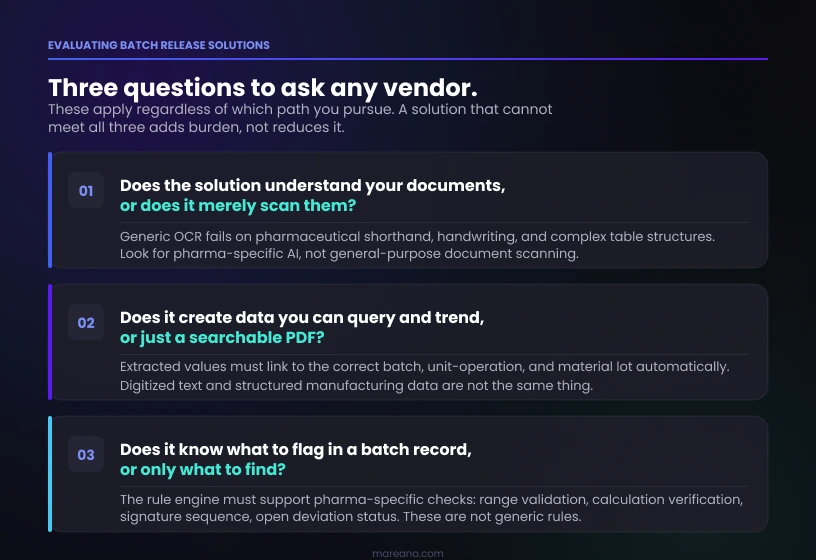
First: look for pharma-specific data extraction, not generic document scanning. The system must understand pharmaceutical vocabulary, complex tabular structures, handwriting variations, and the specific shorthand conventions used in batch manufacturing. Generic optical character recognition tools regularly fail on pharmaceutical documents. They misread abbreviations, lose table structure, and omit handwritten annotations. Before committing to any solution, ask: does this system understand my documents, or does it merely scan them?
Second: verify that extracted data is automatically contextualized into relational structures. Pulling values from a batch record is necessary but insufficient. Those values must be automatically linked to the correct batch identifier, unit-operation, and material lot, so that every data point carries its full manufacturing context without manual data preparation. Without this contextualization, you have digitized text, not structured manufacturing data. A searchable PDF is not a queryable dataset. Ask: does this solution create data I can trend and query, or just a PDF I can search?
Third: demand configurable, domain-specific exception logic. A rule engine must support the pharma-specific checks that actually govern batch release: range validation, calculation verification, signature presence and sequence, open deviation status. A rule engine that flags anything outside a numerical range but cannot verify a calculation or check for a missing supervisor signature is not equipped for regulated batch review. Ask: does this solution know what to flag, or only what to find?
These three criteria represent the floor, not the ceiling.
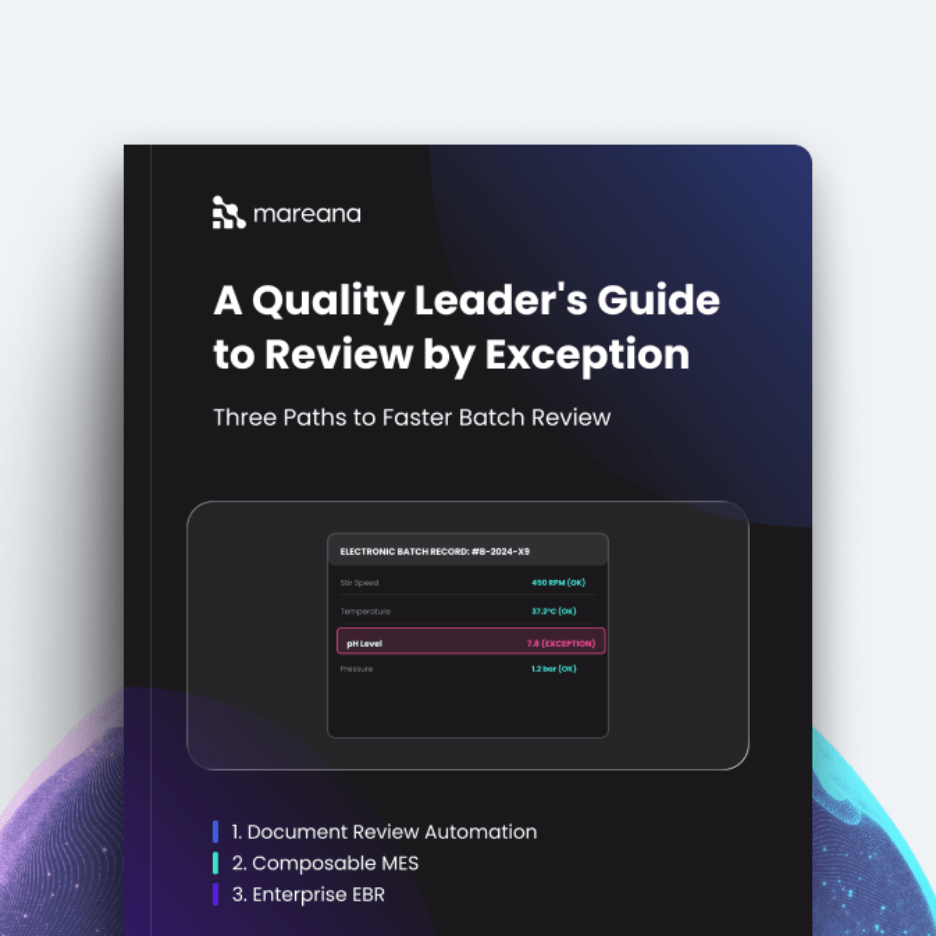
The full guide provides the remaining two evaluation criteria, the compliance rationale for each, and the implementation context for matching evaluation frameworks to your organizational archetype: virtual pharma, CDMO, or integrated manufacturer.
The Deeper Dive
Batch release bottleneck is a data governance problem. It has three architectural solutions, each calibrated to a different organizational reality. Choosing the right pathway depends on your operating model and current digital maturity. The pathway that fits is rarely the one the loudest vendor is selling. It is the one matched to your structure, your capital constraints, and your timeline to deploy.
Review by Exception is not a destination. It is a waypoint on the longer journey: from reactive quality management, where QA is consumed by mechanical verification, toward predictive, data-driven quality culture, where expert judgment concentrates on genuine process signals. That trajectory starts with a single decision: which architecture matches where you actually operate today. The wrong starting point delays the journey. The right one accelerates everything that follows. Choosing well requires evaluating pathways against your operational reality, not against vendor claims.
For the operational and regulatory forces driving this transition, including the EU Annex 11 draft analysis, the FDA QMM connection, and the full Hidden Plant cost quantification, see our companion blog.
Frequently Asked Questions
• Pharma-specific data extraction capabilities
• Automatic contextualization of manufacturing data
• Configurable pharmaceutical exception logic
These features are essential for achieving compliant and scalable Review by Exception processes.


 Learn more