Summary
Pharmaceutical inspection readiness depends on data infrastructure as much as procedural discipline. If the data proving operational control is fragmented, no amount of mock auditing compensates.
• Paper batch records are an active inspection liability. Mareana’s Paper Batch Record Digitization and Batch Review Copilot convert paper into structured, reviewable data and reduce batch release cycle times by up to 50%.
• Investigator data retrieval speed is a direct readiness signal. Mareana’s knowledge graph enables sub-minute retrieval of full batch genealogy, deviation histories, and test results during live inspections.
• Sponsors managing CDMO networks carry non-delegable accountability. Mareana’s Views and Value Stream Map modules provide continuous, harmonized quality oversight across every manufacturing partner.
• AI used in GxP contexts must be deterministic, traceable, and explainable. Mareana’s Lumis co-pilot anchors every AI output to validated source data with a clickable audit trail, satisfying EU GMP Annex 22 requirements.
• The paper-to-digital transition does not have to be a multi-year MES project. Mareana’s EBRx module provides tablet-based electronic data capture in weeks.
Pharmaceutical inspection readiness is the ability to demonstrate operational control at any moment, across every batch, material, and decision point in the manufacturing lifecycle, without advance notice and without scrambling to assemble evidence. That definition sounds simple. In practice, it is the hardest operational discipline in regulated manufacturing.
Most readiness programs focus on the visible layer: updating SOPs, closing the CAPA backlog, drilling front room and back-room teams, running mock audits. These activities matter. But they address behavior, and most inspection findings originate below that layer, in structural gaps across data access, batch traceability, review workflows, and cross-site visibility. A 2026 industry analysis found that data integrity and quality system failures appeared in nearly 60-80% of GMP-related warning letter observations. The pattern is consistent: investigators find problems because the data needed to answer their questions is fragmented across disconnected systems, buried in paper records, or unavailable at the speed an inspection demands.
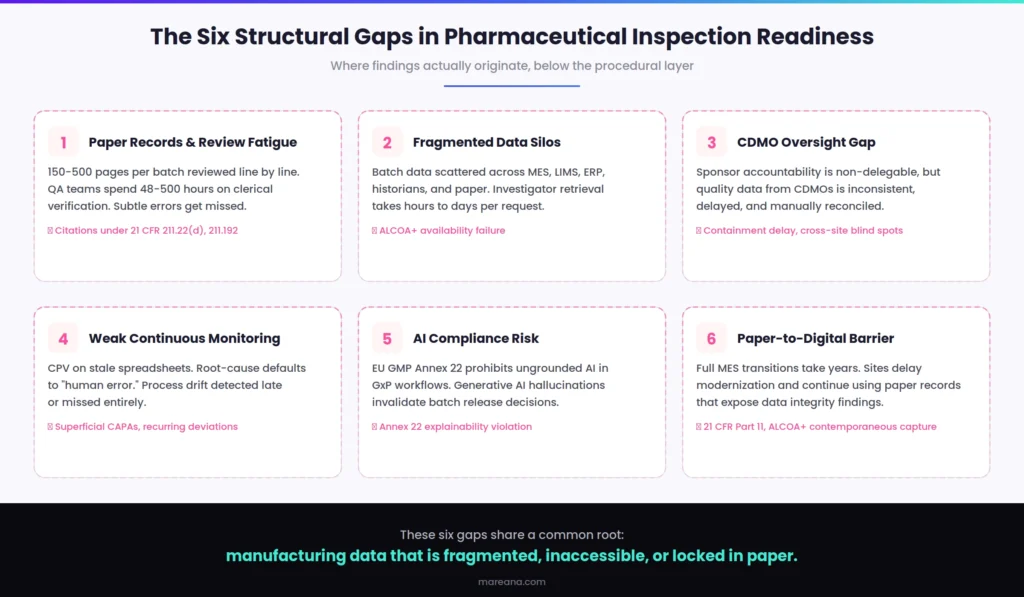
This article examines six structural challenges that undermine pharmaceutical inspection readiness and explains how Mareana’s manufacturing intelligence platform addresses each one.
1. Paper Batch Records and Review Fatigue
The Challenge
A single commercial batch of a biologic or complex drug product can generate between 150 and 500 pages of paper records. QA teams verify timestamps, check arithmetic, confirm specification limits, and ensure every required signature is present. Line by line. Page by page.
This manual audit produces data fatigue. Subtle anomalies and omitted signatures get missed on page 387 of a 500-page record. These documentation oversights are a primary driver of citations under 21 CFR 211.22(d) and 21 CFR 211.192. Batch review times frequently reach 48 to 500 hours per batch, tying QA resources to clerical verification instead of investigation and risk assessment.
When an inspector asks to see the batch record, the quality team presents a thick paper stack. Every uncaught calculation error, missing signature, or out-of-spec value that the reviewer missed is now an observation waiting to be written.
How Mareana Addresses It
Mareana’s Batch Review Copilot then executes algorithmic review by exception on those digitized records. The rule engine validates mathematical calculations (yield reconciliation, assay values, mass balance), verifies numerical bounds against product specifications, and flags missing signatures or skipped steps. QA reviewers focus on the flagged exceptions rather than re-reading every line.
The inspection posture changes. Instead of presenting an unverified 500-page paper stack, QA presents a focused exception summary showing what was flagged, how each flag was resolved, and who signed off.
2. Fragmented Data Silos and Slow Document Retrieval
The Challenge
During an inspection, an investigator in the front room will ask questions that cross system boundaries. Trace a specific lot of excipient across the last twelve batches. Show how a past temperature excursion was investigated and resolved. Confirm whether a process parameter drifted over the last six months of production.
In most facilities, the relevant data lives in separate systems: SCADA or historian for process data, LIMS for lab results, ERP for material movements, QMS for deviations and CAPAs, and physical batch records for execution details. Assembling these records manually takes hours. Sometimes days. And retrieval delays raise immediate suspicion. Investigators interpret slow retrieval as a signal of poor operational control and use it to justify deeper probes into documentation practices.
Under ALCOA+ principles, data must be available when needed. If it takes an afternoon to locate a deviation record tied to a specific lot, availability is not met in any practical sense.
How Mareana Addresses It
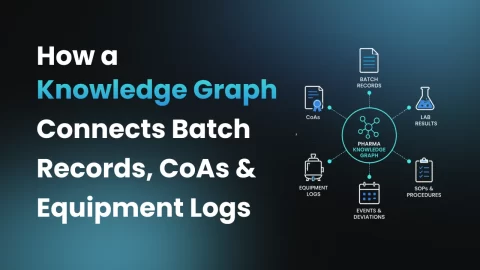
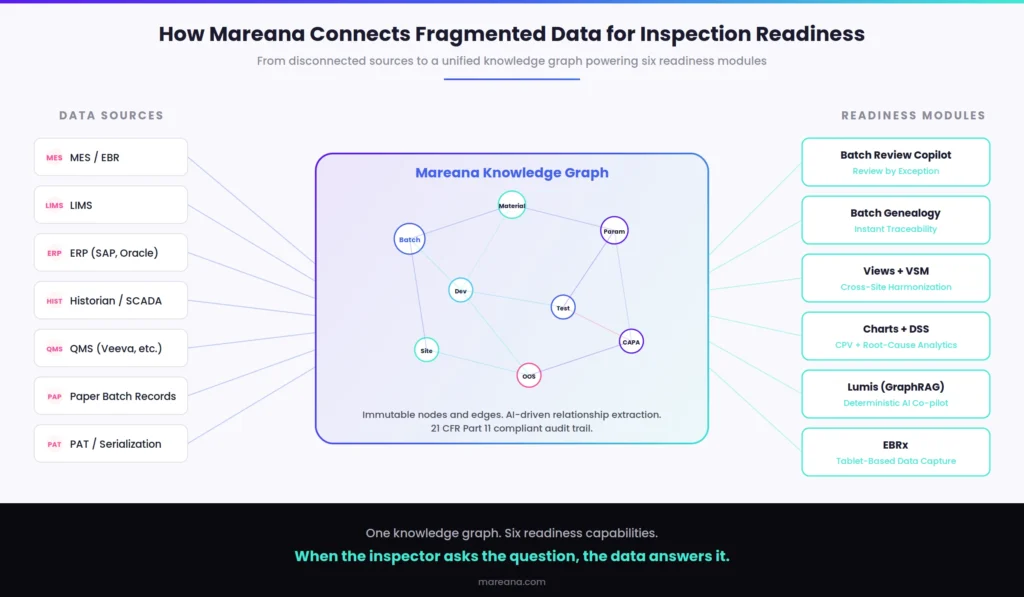
Mareana’s Batch Genealogy module ingests and contextualizes data across MES, LIMS, ERP, historians, PAT systems, and paper records into a unified knowledge graph. The graph connects unit operations and material lots into a single data structure, enabling instant forward and backward traceability without manual assembly.
When the back room receives an investigator request, personnel query the graph to pull full genealogy trees, material consumption histories, and associated deviation records. Retrieval that previously took hours or days completes in minutes. In documented deployments, audit trail retrieval has been demonstrated in under a minute during FDA audits.
The knowledge graph stores genealogy as immutable nodes and edges. AI-driven relationship extraction links entities automatically, which means connecting a raw material lot to every batch it touched, every deviation it was involved in, and every test result it generated does not require manual SQL modeling or custom report building.
Watch related video: Batch Genealogy: End-to-End Traceability in Pharma Manufacturing
3. The CDMO Oversight Gap and Multi-Site Inconsistency
The Challenge
Virtual pharma companies and asset-light manufacturers depend on CDMOs for production. Under regulatory frameworks, product release accountability remains non-delegable: the sponsor company is responsible for every lot, regardless of who manufactured it. When an inspector asks a sponsor for cross-batch trending or audit trails covering CDMO-produced lots, the sponsor often faces a significant blind spot.
Each CDMO and each internal facility uses proprietary software, different units of measure, and different parameter naming conventions. One site calls a parameter “pH.” Another calls it “Acidity.” One records temperatures in Celsius, another in Fahrenheit. Compiling a coherent quality narrative across these sites for a single product is a manual data reconciliation exercise that takes weeks.
The regulatory exposure is direct. If a contaminated raw material is identified and the sponsor cannot quickly demonstrate which batches across which sites were affected, containment is delayed and the inspection finding writes itself.
How Mareana Addresses It
Mareana’s Views module acts as a data governance and harmonization layer. It standardizes varying site nomenclatures (mapping “pH” at Site A to “Acidity” at Site B, for example) and automates unit conversions across production facilities. Sponsors see a single, consistent parameter vocabulary across every site and CDMO in their network.
Mareana’s Value Stream Map (VSM) module maps the physical and financial movement of goods from raw material vendor receipt through finished product shipping. When a contaminated raw material is flagged, the VSM and Views layer identify every impacted lot across internal and external sites. The quality unit can place affected batches on hold and present clear containment evidence to an inspector, with the trace completed in minutes rather than days.
4. Weak Continuous Monitoring and Superficial Root-Cause Investigations
The Challenge
Regulatory guidance, including the PIC/S PI 006-4 lifecycle approach and ICH Q10, has moved decisively away from retrospective validation and single-point testing. Inspectors expect to see continuous monitoring, proactive quality risk management, and scientifically rigorous root-cause analysis. Under 21 CFR 211.192, every unexplained discrepancy must be investigated, and the investigation must be documented.
In practice, many sites run CPV on static spreadsheets that are two or more months out of date. OOS investigations default to assignable cause or human error without multivariate analysis. CAPAs address symptoms rather than root causes. When an inspector asks how a specific process drift was detected and what corrective action was taken, the answer often reveals that the drift was detected late (or not at all) and the investigation lacked analytical depth.
How Mareana Addresses It
Mareana’s Charts module delivers real-time Statistical Process Control (SPC) charting to support Continued Process Verification (CPV) and Ongoing Process Verification (OPV). Control charts auto-refresh from live batch data, which means CPV dashboards reflect the current state of the process rather than a snapshot from two months ago.
Mareana’s Data Science Studio (DSS) and No-Code Machine Learning module enable quality engineers and process specialists to conduct multivariate analysis, design of experiments, and root-cause analysis without custom software development.
Mareana’s APQR module pulls harmonized batch, deviation, and process capability metrics directly from the knowledge graph for Annual Product Quality Review reports. A compilation exercise that typically consumes a month of work per site per year is reduced to days.
5. AI Compliance and the Risk of Algorithmic Hallucinations
The Challenge
EU GMP Annex 22 established strict boundaries for deploying AI in critical GxP manufacturing operations. Generative AI models and large language models that produce ungrounded, probabilistic outputs are prohibited from autonomous GxP release workflows. Health authorities require that every automated conclusion be deterministic, reproducible, and verifiable against an immutable audit trail.
This creates a compliance problem for any manufacturer considering AI-assisted batch review or quality decision support. If the AI generates a summary or recommendation that cannot be traced back to a specific validated data source, an inspector can challenge every conclusion that rests on it. The term regulators use is “hallucination,” and a single hallucinated data point in a batch release decision invalidates the entire review.
How Mareana Addresses It
Mareana’s Lumis AI co-pilot operates on a Graph Retrieval-Augmented Generation (GraphRAG) architecture anchored to the batch genealogy graph. Lumis translates natural language questions into structured queries against validated data. It does not generate text from open-ended language model assumptions. Every insight and calculation carries a clickable “View Source” verification link that takes the reviewer directly to the underlying system record and its audit trail.
Deterministic guardrails keep investigations within the validated boundary of the batch record. Template parameters and role-based permission controls constrain what queries can run and what data they can access. The system does not decide. The reviewer decides, using answers the system can prove.
This architecture satisfies Annex 22 explainability and data provenance requirements. In a front room discussion, QA can navigate from a Lumis summary directly to the validated source data. Every step is auditable. Nothing is generated without a traceable origin.
Related Video: Accelerating Root Cause Analysis with an AI Chatbot
6. The Paper-to-Digital Transition Barrier
The Challenge
Traditional transitions from paper batch records to electronic execution platforms (MES or EBR systems) take years of software engineering, extensive validation cycles, and disruptive floor retraining. Many facilities delay modernization because the implementation timeline, cost, and operational disruption exceed what the organization can absorb.
The result is that sites continue using paper logbooks and manual batch manufacturing records that expose them to data integrity findings during inspections. Post-dated signatures, missing fields, transcription errors, and illegible entries are endemic to paper-based operations. Each one is a potential observation under 21 CFR Part 11 and ALCOA+ requirements for contemporaneous, legible, and accurate records.
How Mareana Addresses It
Mareana’s Paper Batch Record Digitization (PBRD) converts scanned paper records into structured key-value databases using AI-OCR paired with human-in-the-loop verification. The system handles handwriting, checkboxes, signatures, and annotations specific to pharmaceutical batch records. Structuring this data ensures it meets the “Original” and “Accurate” requirements of ALCOA+.
Mareana’s EBRx module converts existing paper batch record pages into visual data-entry screens for mobile tablets within weeks, without the multi-year implementation timeline of a full MES rollout. Active boundary checks integrate input constraints, out-of-range warnings, and role-based signature restrictions directly into the tablet fields.
Operators enter data at the point of work, on the device, with the system enforcing contemporaneous capture. Transcription errors, missing fields, and post-dated sign-offs are eliminated at the source. The electronic records comply with ALCOA+ principles and create a clean, legible audit trail that investigators can examine without sorting through handwritten pages.
Sites that have deployed EBRx report completing the transition for a single product line in four to six weeks, including template conversion, validation, and floor training. For facilities that cannot justify or fund a full MES implementation, EBRx provides a practical bridge: electronic data capture and enforcement on the shop floor, feeding directly into Mareana’s digitization and review workflows.
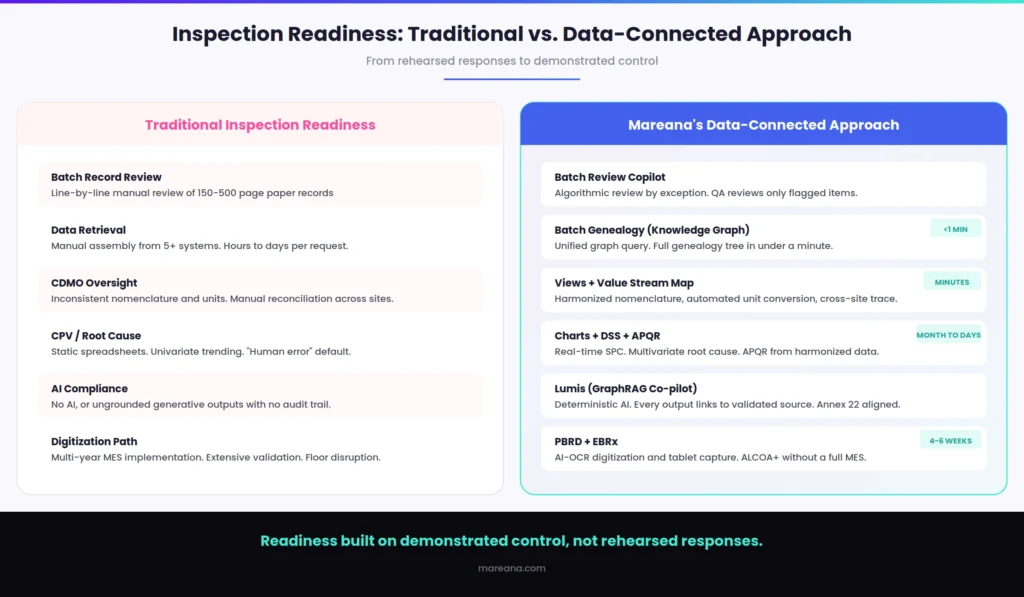
Inspection Readiness: Traditional Approach vs. Data-Connected Approach
The following comparison illustrates how a data-infrastructure-first approach changes the inspection readiness posture across six key dimensions.
Conclusion
Pharmaceutical inspection readiness is a data problem before it is a behavioral one. The six challenges outlined here share a common root: manufacturing data that is fragmented, inaccessible, unstructured, or locked in paper. No amount of SOP revision, mock auditing, or team drilling overcomes a data infrastructure that cannot produce answers at the speed an inspection requires.
Mareana’s platform addresses these structural gaps by connecting and contextualizing manufacturing data across every source, site, and partner into a single knowledge graph. Paper records become structured, reviewable data. Batch genealogy becomes queryable in seconds. CDMO oversight becomes continuous. CPV becomes real-time. AI becomes deterministic and traceable. And the paper-to-digital transition becomes a matter of weeks rather than years.
The result is a readiness posture built on demonstrated control rather than rehearsed responses. When the inspector asks the question, the data answers it.
See how Mareana builds inspection readiness into your data infrastructure
Readiness is a data problem before it is a procedural one. Mareana connects batch records, lab results, process parameters, and deviation histories across every site and manufacturing partner into a single queryable knowledge graph, so the evidence is ready before the inspector asks for it.
- Review by exception on digitized batch records
- Forward and backward batch traceability
- Harmonized oversight across CDMO networks
- Real-time CPV and multivariate root cause
- Annex 22-aligned, traceable AI
- Paper-to-tablet capture without a full MES
See the platform applied to your batch records, sites, and partners.



 Learn more