Summary
Continuous inspection readiness is the ability of a pharmaceutical manufacturer to maintain inspection-ready records, documentation, and evidence at all times, without relying on advance notice to prepare. As FDA inspection practices shift toward less predictable notice periods, traditional inspection playbooks based on last-minute record gathering are becoming less effective.
This article explains what changed, why disconnected records create inspection-readiness gaps, and how manufacturers can build an operating model that supports faster, more reliable evidence retrieval during inspections.
For most of the last two decades, readiness was a race you could see coming. Notice arrived, the team mobilized, and the records were assembled into presentable shape before anyone walked through the door. That cushion is largely gone.
You have almost certainly read the policy alerts by now. A dozen firms published near-identical summaries of what FDA announced in 2025, and most quality leaders can recite the changes. What almost nobody published is the operating model that works once the notice period disappears.
This post covers four things: what actually changed, how big the enforcement shift really is compared with the figure most people are citing, why the standard preparation of playbooks stopped working, and a test you can run this afternoon. One piece of context first. Record and documentation gaps, not scientific failures, drive the majority of inspection findings, and the reasons for that are covered in a companion post on the disconnected batch record state.
What changed in 2025
For years, foreign and contract sites operated with a cushion that domestic sites never had. Nearly 90% of FDA’s foreign inspections in fiscal year 2023 were pre-announced, according to analysis by White & Case. That advance notice was not a courtesy. It was the structural precondition for the entire preparation model, because it gave teams the days or weeks needed to gather scattered records into a presentable whole. Investigators still found serious deficiencies more often abroad than at home, even with warning given.
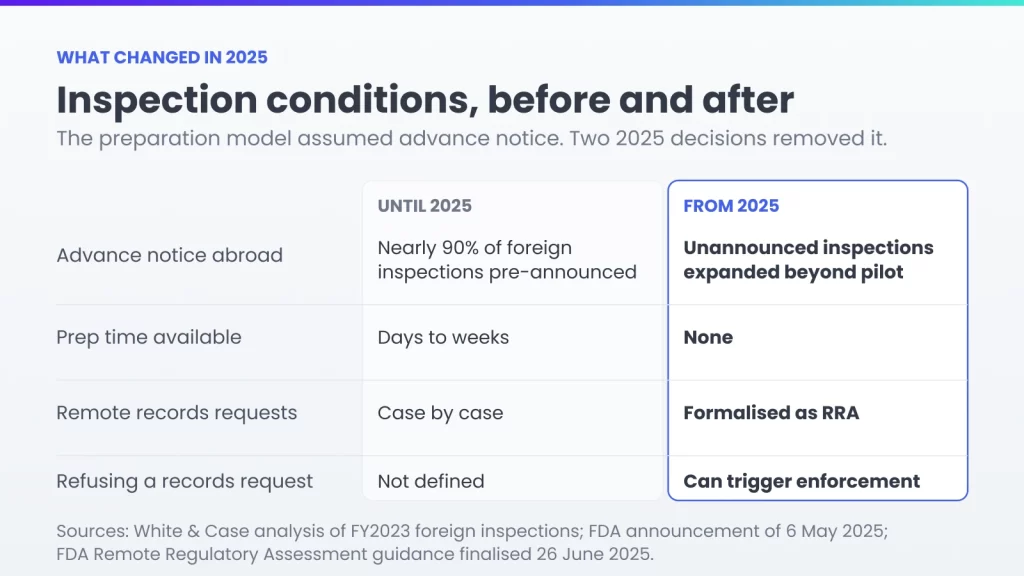
Two decisions in 2025 removed it. FDA finalized its Remote Regulatory Assessment guidance on June 26. Earlier, on May 6, the agency announced an expansion of unannounced foreign inspections beyond the earlier India and China pilot, building on an executive order issued the previous day. The Commissioner framed the change as ending a double standard between foreign and domestic oversight, which is a fair description of what it does. Domestic sites have operated without notice for a long time.
The practical effect of both moves is the same. The preparation race increasingly starts without a starting gun. For a site that has been running on advance notice, this is not a marginal change in difficulty. It removes the single variable the whole approach was built around. A team that could reliably produce a connected batch history in three days is now being asked to produce it in three hours, using the same systems and the same people.
How big the enforcement increase really is
Enforcement is intensifying alongside the policy shift, and here the honest number matters more than the loud one. Both figures below are real. Only one of them is about drugs.
A figure circulating widely puts warning letters at 327 for the second half of 2025, a 73% year-over-year jump. That count spans all FDA centers, including food, device, and cosmetics, and was inflated further by a September 2025 advertising enforcement crackdown. It is not a drug story. The drug- and biologics-specific figure is 303 warning letters for fiscal year 2025.
Findings escalate because it bears on everything below. An observation on a Form 483, the form an investigator uses to record observations at the close of an inspection, is a question rather than a verdict. A weak, slow, or evasive answer is what turns it into a warning letter, and that answer has to be built from the same history the inspector asked to see.
Why prep playbooks stopped working
Most of the industry’s readiness toolkit is a set of accelerators for manual assembly. Inspection playbooks, mock inspections, front room and back room drills: all of it makes assembly faster and more practiced. The front room is where the inspector sits and requests arrive; the back room is where those records are located, checked, and prepared before they go forward.
None of it removes the assembly. These practices optimize the runner’s route to the records. They do not change the fact that a runner is dispatched.
Which is why the fire drill never ends. Each inspection re-runs the same assembly from scratch. So does each deviation investigation. So does each recall. The work repeats not because the team forgot how, but because the answer was never held as a whole in the first place, so there is nothing to hold on to between events.
None of this means the playbooks got worse. They were built around a head start, and the head start is what went away. The methods are unchanged; the conditions they were designed for are not, which is a harder problem than under-performance, because there is nothing obviously broken to fix.
Which raises a different question from the one the industry has been asking. For two decades the question has been how to prepare better and faster; the more useful question now is whether the answer already exists, connected and retrievable, before anyone asks.
The retrieval test you can run today
Before anything else, there is a test worth running, and it costs nothing. The five-minute rule is an informal practitioner benchmark holding that any requested document should be retrievable within five minutes. It has no regulatory basis, and that is worth saying plainly, because a good deal of content presents it as though it were a standard. It survives because it is a useful proxy: retrieval speed is how practitioners find out whether a connected record actually exists, not something anyone is graded against.
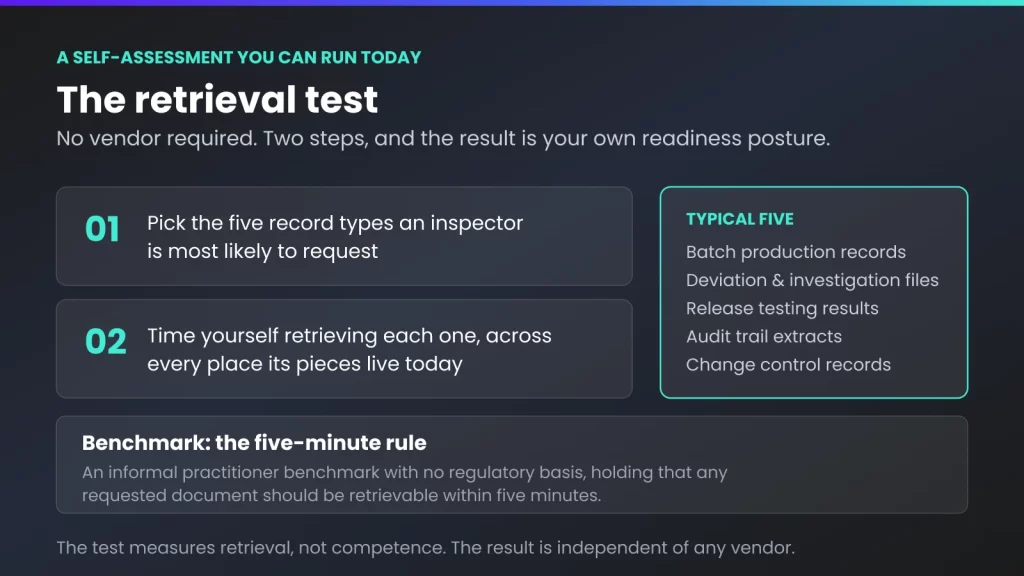
- Pick your five most-likely-requested record types. The batch records, deviation files, and laboratory results an inspector reaches for first. Choose the ones you would be asked for on a normal Tuesday, not the ones you are proudest of.
- Time yourself against the five-minute benchmark for each one. Honestly, with a clock, across every place the pieces actually live today. Not the theoretical retrieval path, and not the one that assumes the person who knows where everything is happens to be in the building.
What comes out of that is your real readiness posture, independent of any vendor. The instruction that matters most is the one about every place the pieces live today, including the systems and the sites you do not control.
This is the front half of a longer assessment.
Whitepaper
Two steps down. Two to go.
If your five-minute test did not go the way you hoped, the full diagnostic is worth the twenty minutes. Our whitepaper Show Me How This Was Made carries the remaining assessment steps with their thresholds, alongside a worked example of what a connected record architecture looks like in practice.
Read the whitepaperWhat changes when the answer already exists
A failed retrieval test is not a verdict on your team’s effort. It describes how your records are arranged, which is a different kind of problem and a more tractable one.
A different category of approach starts from the opposite premise. Capture manufacturing history as connected, queryable relationships in the first place, so that “show me how this was made” becomes a lookup rather than a rebuild. Answering how a given batch was made turns into a search across a connected lineage rather than a manual assembly from separate systems. Such a lineage can be built from paper records received from a manufacturing partner, from electronic batch records held in-house, or from direct integration with an ERP system, which matters because most organizations cannot start from a clean slate.
There is a fair objection here and it deserves a straight answer. AI and data integrity in a regulated environment is a live concern, and a reasonable one. Retrieval built on validated, traceable records is a different proposition from generative guesswork, and the distinction is not rhetorical: an approach earns trust in this setting by keeping every answer traceable back to its validated source, which is the opposite of an unaccountable guess.
None of this is a promise that technology fixes readiness. A system does not fix a weak process, and the seam between paper and electronic does not close because new software arrived. The point is architectural rather than transactional. Knowing whether the answer to how a product was made already exists as a connected whole in your organization is worth more than any purchase decision that follows from it.
The one question to ask of anything you build or buy next
Let one criterion govern whatever you build or buy next: does the answer already exist as connected relationships, or as fragments awaiting assembly? It is a single question, and it does more work than a scorecard, because it discriminates between approaches that look similar in a demonstration.
A system that merely stores more documents faster still leaves the runner running. A record architecture in which lineage is connected changes the posture itself, which is a different class of outcome from a faster search box. Apply the question regardless of vendor, including to anything published here, and including to us.



 Learn more