Welcome to the 10th edition of Mareana Deep Dive. This edition includes our updates from August and September 2026 focusing majorly on inspection readiness.
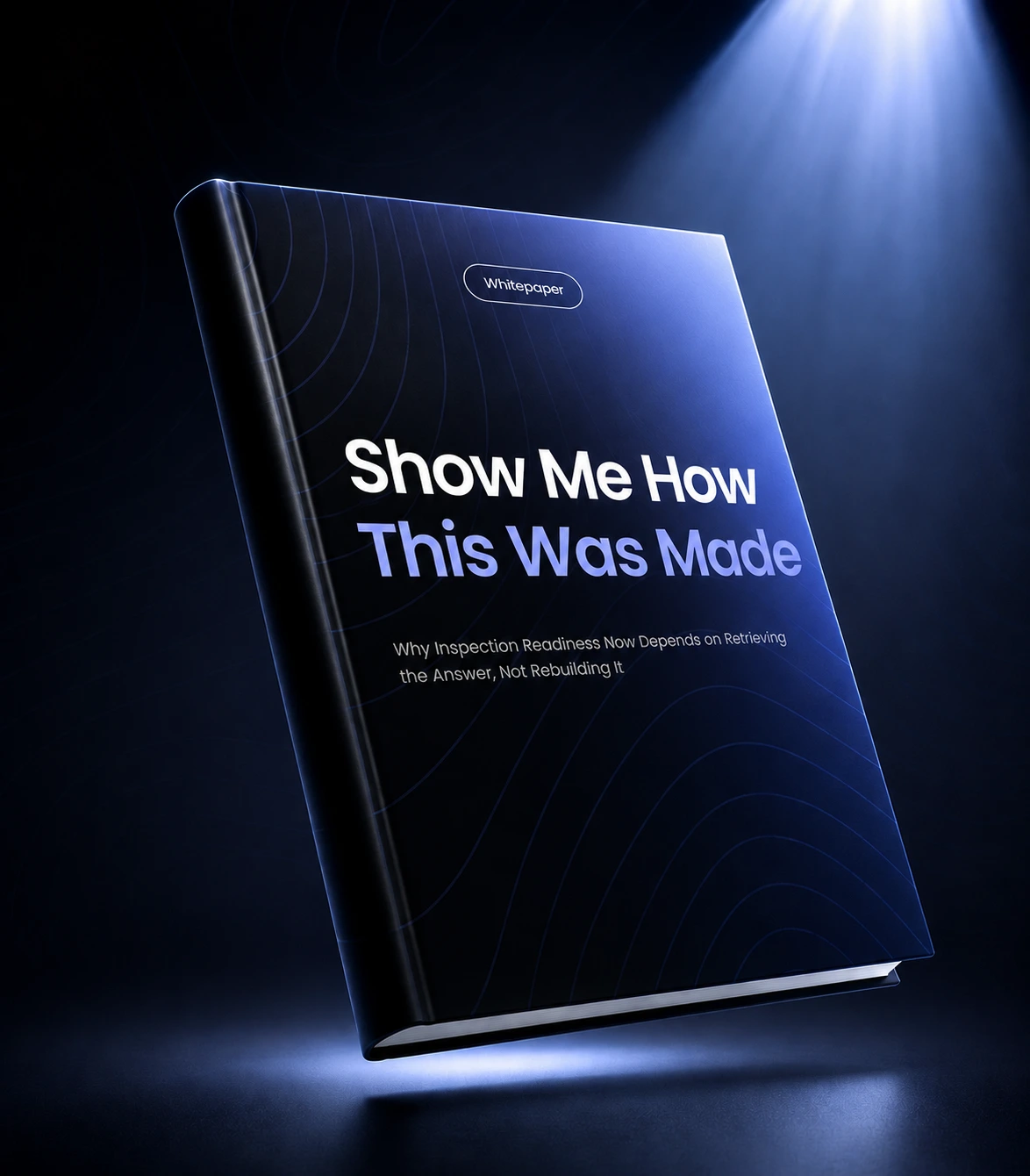
[Whitepaper] Show Me How This Was Made
Inspection readiness depends on how quickly an organization can show how a product was made. When manufacturing history is scattered across paper records, legacy systems, laboratory data, and external partners, teams must reconstruct that story under pressure. This whitepaper explores how connected manufacturing records can shift organizations from manual reconstruction to rapid retrieval, creating a more continuous and defensible approach to inspection readiness.
You can access the whitepaper here: Show Me How This Was Made
[Blog] Data Foundations for AI in Pharma: What AI-Ready Really Means
Data lake stores manufacturing values. A data foundation knows which batch produced them, which equipment was running, which specification applied at the time, and which document page they were read from. That difference explains why AI pilots in pharmaceutical manufacturing clear proof of concept and then stall before production: the model works, and the contextualisation the data scientist did by hand never got built into a pipeline.
This article defines what a data foundation is in a GMP context, why batch-level context is a requirement that lakehouse and data mesh architectures do not supply on their own, and what changed once regulators began treating data provenance as part of a model’s credibility case.
Read Data Foundations for AI in Pharma.
[Blog] Why Disconnected Batch Records Create the Biggest Inspection Risk
Most manufacturers keep a batch’s history across paper binders, laboratory systems, manufacturing execution systems and shared drives. Each part is accurate. Nothing connects them. This blog covers what the record gap data actually shows, why an electronic quality management system does not resolve it, and why paper is not the thing to blame.
Paper is not the problem, and neither is a mix of paper and electronic. The problem is disconnection: records that are individually accurate and collectively unable to answer a single question. That is a record-architecture problem, and it is solvable without replacing what you already have.
Mareana connects manufacturing history across paper batch records, laboratory systems, manufacturing execution systems and enterprise sources into one queryable lineage, so the answer to how a batch was made exists as a connected whole before anyone asks for it.
Read our blog Why Disconnected Batch Records Create the Biggest Inspection Risk to dig deeper.
[Blog] Continuous Inspection Readiness for Zero-Notice FDA Inspections
Continuous inspection readiness is the ability of a pharmaceutical manufacturer to maintain inspection-ready records, documentation, and evidence at all times, without relying on advance notice to prepare. As FDA inspection practices shift toward less predictable notice periods, traditional inspection playbooks based on last-minute record gathering are becoming less effective.
This article explains what changed, why disconnected records create inspection-readiness gaps, and how manufacturers can build an operating model that supports faster, more reliable evidence retrieval during inspections.
Read Continuous Inspection Readiness for Zero-Notice FDA Inspections to learn more.
[Blog] How Smart Manufacturing in Pharma Is Changing in 2026
Smart manufacturing in pharma is usually presented as a technology story about connected plants, sensors, and predictive analytics.
This article sets out what those changes mean for batch release specifically: the expanded audit trail expectations in the revised Annex 11, including the requirement to capture data creation events and link trails to batch records; the line draft Annex 22 draws around AI in GMP-critical applications, where only static, deterministic models are permitted and generative AI and large language models are excluded; where review by exception produces real cycle time gains without reducing oversight; and why batch disposition remains non-delegable for sponsors whose product is made at a CDMO. It closes with six preparation steps QA and compliance leaders can sequence before the fourth quarter.
Learn the How Smart Manufacturing in Pharma Is Changing in 2026.
[Blog] Pharmaceutical Inspection Readiness with Mareana
Pharmaceutical inspection readiness depends on data infrastructure as much as procedural discipline. If the data proving operational control is fragmented, no amount of mock auditing compensates.
• Paper batch records are an active inspection liability. Mareana’s Paper Batch Record Digitization and Batch Review Copilot convert paper into structured, reviewable data and reduce batch release cycle times by up to 50%.
• Investigator data retrieval speed is a direct readiness signal. Mareana’s knowledge graph enables sub-minute retrieval of full batch genealogy, deviation histories, and test results during live inspections.
• Sponsors managing CDMO networks carry non-delegable accountability. Mareana’s Views and Value Stream Map modules provide continuous, harmonized quality oversight across every manufacturing partner.
• AI used in GxP contexts must be deterministic, traceable, and explainable. Mareana’s Lumis co-pilot anchors every AI output to validated source data with a clickable audit trail, satisfying EU GMP Annex 22 requirements.
• The paper-to-digital transition does not have to be a multi-year MES project. Mareana’s EBRx module provides tablet-based electronic data capture in weeks.
Learn the Pharmaceutical Inspection Readiness with Mareana.
[Video] AI-Powered Batch Record Review: Structured Review by Exception
How Mareana uses AI-powered batch record review to support a structured Review by Exception process for paper batch records. This video walks through batch record classification, data extraction, automated rule checks, and exception review. See how reviewers can focus on flagged items, distinguish OCR issues from true failures, document review decisions, and maintain a clear history of batch review outcomes.
[Video] AI in GMP Manufacturing: The 4 Frameworks That Decide What You Can Deploy
Four regulatory frameworks define what compliant AI looks like in pharmaceutical manufacturing today: FDA’s existing CGMP regulations, the EU’s draft Annex 22, the joint FDA-EMA principles for good AI practice, and the standards body layer of ISPE GAMP and ISO/IEC 42001. This video covers what each one requires and where they draw hard lines.
[Video] 7 Factors You Should Know Before Using AI for Batch Reviews
AI-powered batch review promises faster release cycles, but only if the underlying data architecture supports end-to-end traceability, validated audit trails, and regulatory compliance. This video covers seven evaluation dimensions every pharmaceutical QA and operations leader should assess before selecting AI batch review software.
[Video] Review by Exception Without an MES: 3 Proven Pathways for Pharma
Can you implement review by exception without an enterprise MES? Yes. Review by exception does not require a full Manufacturing Execution System. 3 distinct architectural pathways exist, each suited to a different stage of operational maturity: Document Review Automation for paper-dependent operations and virtual sponsors, Composable MES for mid-maturity manufacturers and multi-client CDMOs, and Enterprise EBR/MES for fully integrated sites with the capital and timeline to support it.
[Inside Mareana] Events and Celebrations
Recognizing Great Work, Celebrating Great People
Innovation in Action: Our Hackathon Highlights
Creating a Culture Where Health and Well-Being Matter
Subscribe to our Newsletter – Mareana Deep Dive



 Learn more