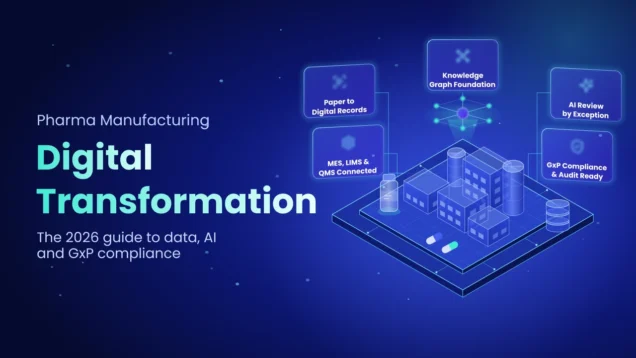
Digital transformation in pharma has moved past the question of whether to digitize. Most manufacturers already run an MES, a LIMS, a QMS and an ERP. The work in 2026 is connecting those systems, plus the paper records that still arrive from contract manufacturers, into one record per batch that people and AI can query, trust and defend during an inspection.
This guide is for quality, manufacturing IT and digital transformation leaders in pharma and biotech. It covers what digital transformation means inside a GMP operation, what changed in 2026, how AI is being used on manufacturing data, where regulators draw the line, and how to judge your own readiness.
Key takeaways
- Digital transformation in pharma manufacturing is decided at the data layer. Connected, contextualized batch data is what makes analytics, release decisions and AI trustworthy.
- In 2026, AI is the main driver of digital transformation in pharma, and regulators are setting the guardrails. FDA’s first warning letter citing AI misuse and the EU’s draft GMP Annex 22 both keep the quality unit accountable for AI-assisted work.
- One of the defining architecture shifts in pharma digital transformation is the move from data lakes to a knowledge graph, which links every value to its batch, step, material lot and equipment.
- Digital transformation pays back fastest in quality workflows: digitizing paper batch records, reviewing batch records by exception, investigating deviations across systems and automating continued process verification.
- For virtual and asset-light pharma, digital transformation reaches beyond their own walls. Success depends on getting usable data from CDMOs while keeping accountability for release.
In this guide
- What is digital transformation in pharma manufacturing?
- Why AI is at the center of digital transformation in pharma
- Digital transformation trends in pharma for 2026
- Pharma manufacturing systems, then and now
- Why digital transformation in pharma stalls
- Data lake, data foundation and knowledge graph
- What contextualization means in practice
- How AI is used in pharma manufacturing today
- Where AI must not act in GxP manufacturing
- GxP compliance challenges and how to handle them
- Digital readiness in pharma: a five-level model
- Digital transformation across a CDMO network
- How Mareana approaches digital transformation
- Frequently asked questions
1. What is digital transformation in pharma manufacturing?
Digital transformation in pharmaceutical manufacturing is the move from paper records and disconnected systems to a connected, contextualized data foundation. On that foundation, teams make, review, release and defend batches with evidence they can retrieve in minutes. In 2026 it also includes governed AI that extracts, checks and investigates manufacturing data, while every decision stays under human approval and 21 CFR Part 11 controls.
Digitization, digitalization and digital transformation
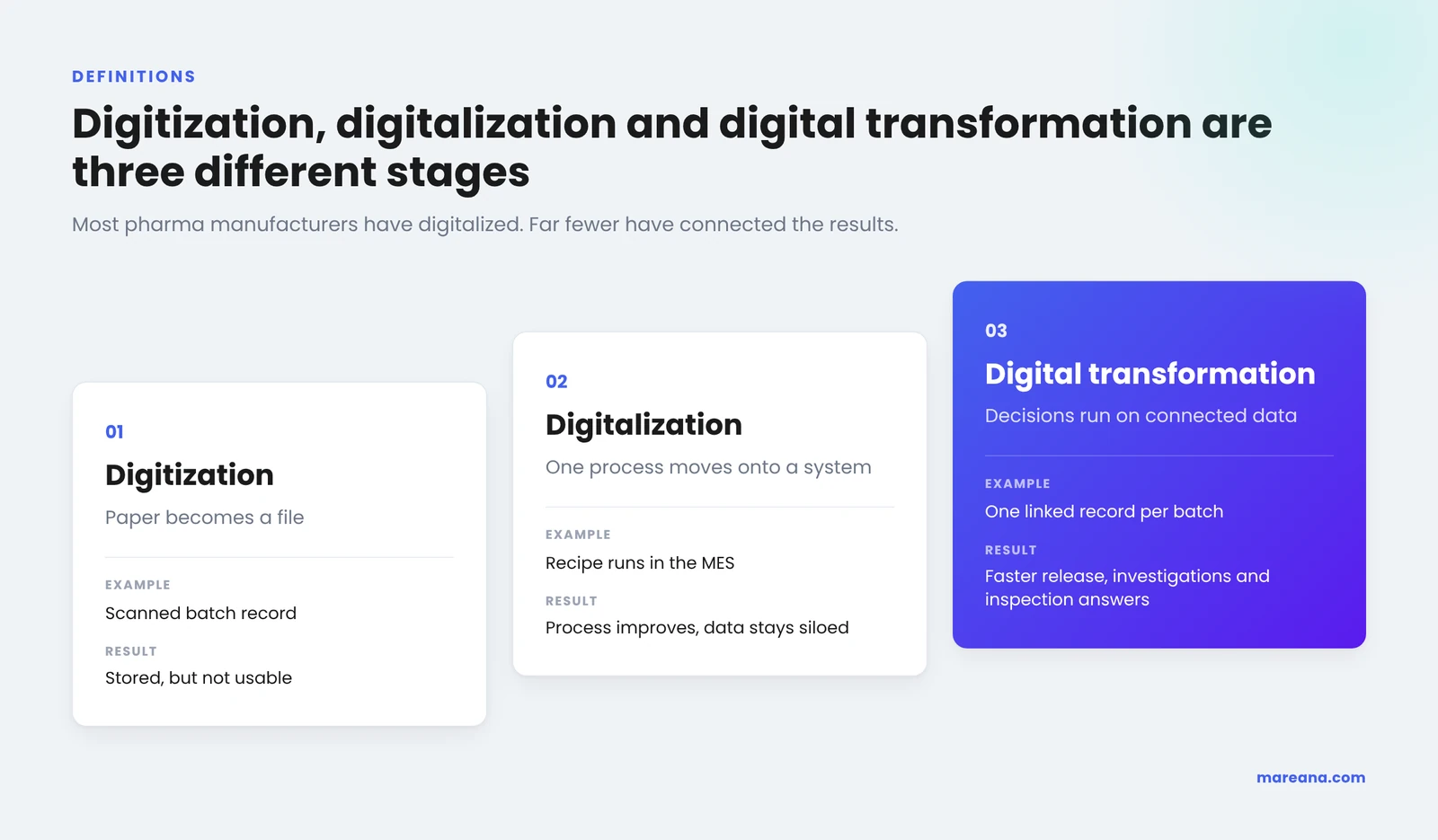
The three terms are often used interchangeably, but they describe different stages of work.
Digitization: converting a paper record into a digital file, such as a scanned batch record. The information exists electronically, but it cannot be queried or trended.
Digitalization: moving a single process onto a system, such as running a recipe in an MES or recording lab results in a LIMS. Each process improves, and the data stays inside that system.
Digital transformation: changing how batches are made, reviewed, released and defended, using connected data from every system and the operating model that goes with it. Quality decisions draw on the whole record for a batch, wherever each part of it was created.
Most pharma manufacturers have digitalized a great deal. Far fewer have connected the results.
Pharma 4.0: the framework behind the term
Pharma 4.0 is ISPE’s adaptation of Industry 4.0 to regulated pharmaceutical manufacturing. Its operating model has four elements: Resources, Information Systems, Organization and Processes, and Culture. Two enablers sit underneath them: Digital Maturity and Data Integrity by Design (ISPE).
The difference from Industry 4.0 is the regulatory layer. In a GMP plant, every new data flow, algorithm and automated check has to meet data integrity and validation expectations before it can support a quality decision.
How digital transformation improves efficiency on pharmaceutical production lines
On the production floor, the efficiency gains come from removing manual handoffs between systems and people.
- Data is captured at the point of execution. Operators enter values on screens that check ranges, step order and signatures in real time, which removes transcription and late corrections.
- Equipment and material status is checked before a step proceeds. Cleaning records, equipment logs and material release status are confirmed automatically instead of by phone or paper.
- Batch records are reviewed by exception. QA reviews the flagged items instead of every field.
- Investigations start with the evidence already linked. Teams spend their time on root cause instead of collecting data from four systems.
- Process data is analyzed across batches. Multivariate analysis on contextualized data finds yield and cycle-time improvements that single-batch views miss. In one documented deployment, scaled-up multivariate analysis led to a $200M per year increase in yield for a global pharmaceutical company.
2. Why AI is at the center of digital transformation in pharma
AI is at the center of digital transformation in pharma because it is the first technology that can act on connected manufacturing data at the speed and volume plants now produce it. Earlier waves digitized records and connected systems, and that work created more data than quality teams can review by hand. AI reads unstructured records, checks every parameter and answers questions across systems, which turns a digital foundation into faster release, investigation and compliance decisions.
Digitalization created more data than people can use
Every batch now leaves records in the MES, LIMS, QMS, ERP and historian, plus paper from the shop floor or a CDMO. Connecting those systems makes the data available, but someone still has to read it. In most quality teams, batch record review and data collection for investigations are still manual, so review effort grows with every batch while headcount does not. See the hidden costs of manual batch record review.
Most of pharma’s operational knowledge is unstructured
Deviation narratives, investigation reports, CAPA records, handwritten batch record entries, certificates of analysis and SOPs hold much of what a plant knows. Rule-based software and dashboards cannot read them. AI can extract values from a handwritten page, compare a new deviation with past ones and summarize what an investigation found, which brings this knowledge into decisions. Read more on addressing manual data wrangling in pharma with AI and how AI is changing quality control.
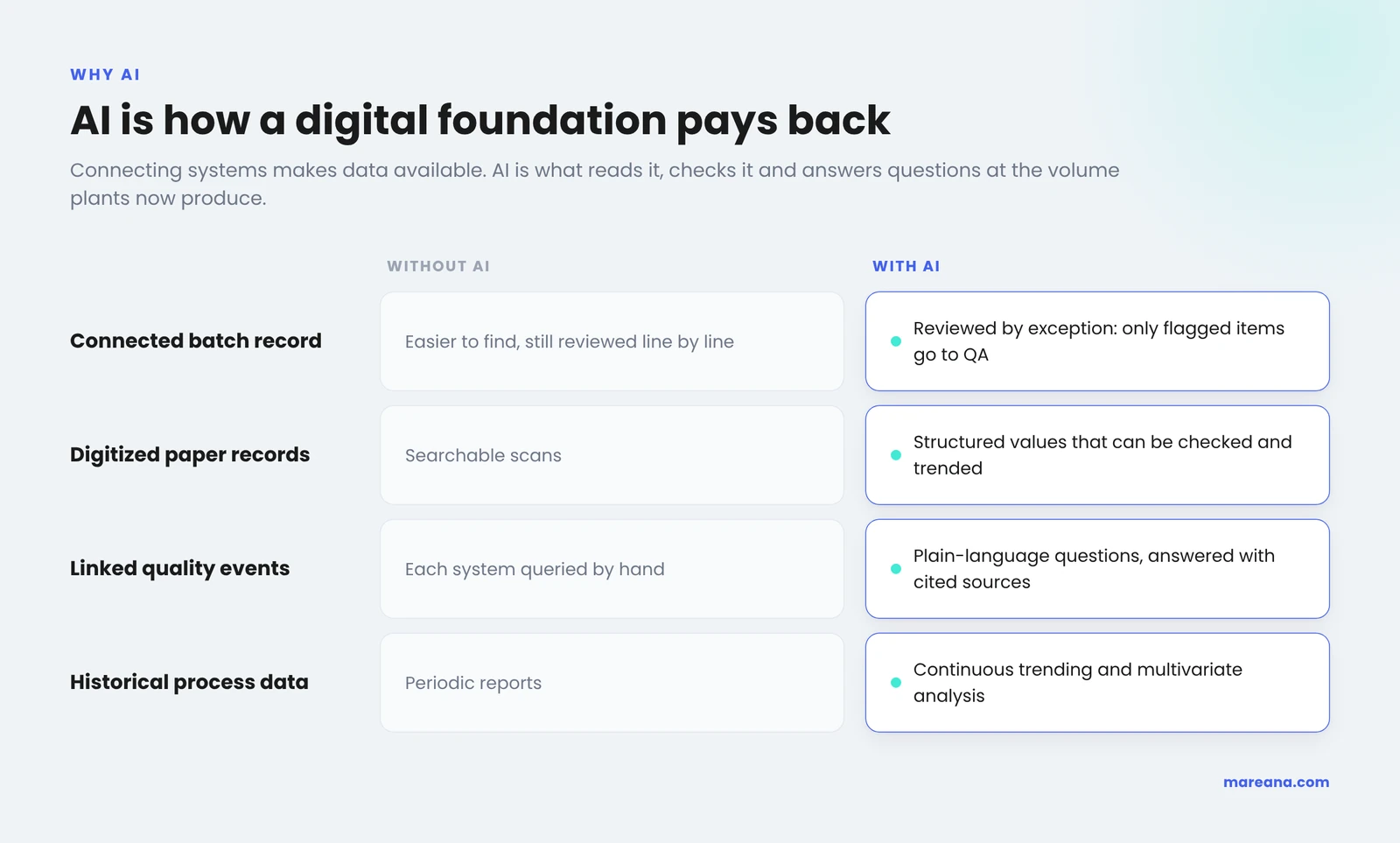
AI is how a digital foundation pays back
| Digital capability | Value without AI | Value with AI |
|---|---|---|
| Connected batch record | Data is easier to find, and still reviewed line by line | Reviewed by exception, with only flagged items sent to QA |
| Digitized paper records | Searchable scans | Structured values that can be checked and trended |
| Linked quality events | Investigators query each system by hand | Plain-language questions answered with cited sources |
| Historical process data | Periodic reports | Continuous trending and multivariate analysis across batches |
AI raises the bar for data and governance
AI is only as reliable as the data beneath it. A model working on misaligned IDs, missing context or unverified transcriptions produces confident answers that are wrong, which in GMP is a compliance problem as well as an operational one. That is why this guide treats the data foundation, contextualization and governance as part of the AI story, and why regulators now focus on how AI outputs are reviewed and approved. For a closer look, read Data Foundations for AI in Pharma: What AI-Ready Really Means and AI in Pharma Manufacturing: A Deep Dive.
How this guide is organized
Sections 3 to 5 cover what is changing in 2026 and why programs stall. Sections 6 and 7 cover the data foundation AI depends on. Sections 8 to 10 cover how AI is used, where it must not act and how to stay compliant. Sections 11 to 13 cover readiness, CDMO networks and Mareana’s approach.
3. Digital transformation trends in pharma for 2026
In 2026, digital transformation in pharma is being driven by AI. Employees already use AI tools in their daily work, and manufacturers are working to bring that productivity into their operations. Because AI can be wrong or hard to explain, regulators are now defining how it may be used in GMP manufacturing, and those rules shape every digital transformation program.
Adoption starts with people, then reaches the plant
- People are already using AI. In Microsoft and LinkedIn’s 2024 Work Trend Index, a survey of about 31,000 people in 31 countries, 75% of knowledge workers said they use generative AI at work, and 78% of those users bring their own AI tools (Microsoft).
- Pharma companies use AI widely outside the plant. In CRB’s 2026 Horizons: Life Sciences survey of more than 400 R&D and manufacturing professionals, 56% apply AI to administrative workflows and 45% use it in drug discovery (BioSpace).
- Regulated manufacturing lags behind. In the same survey, fewer than 10% of drugmakers are scaling AI to support clinical or commercial manufacturing, and 31% plan to use AI in regulated manufacturing within three years.
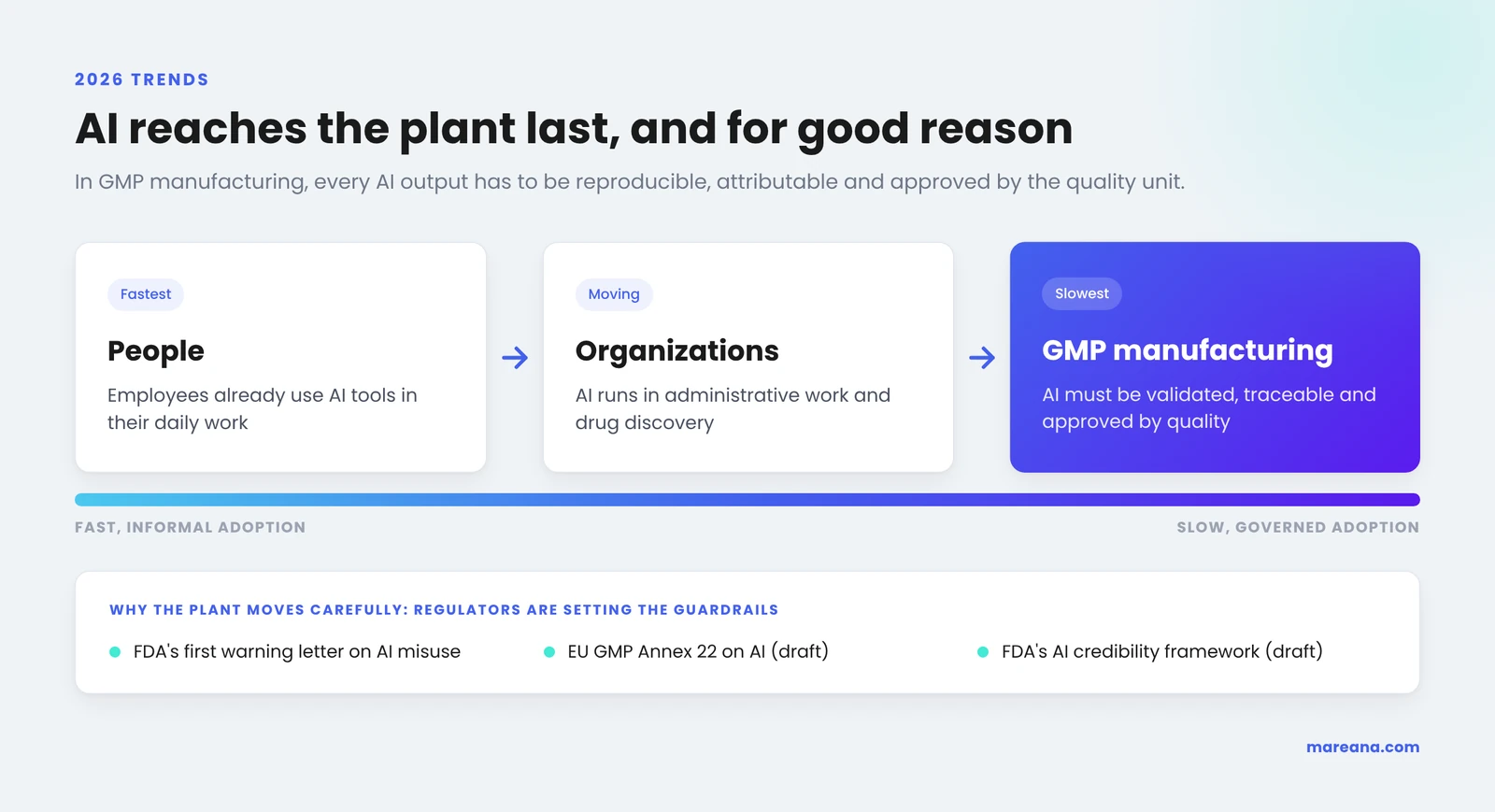
The gap between how people work and what plants allow is where digital transformation programs now focus: bringing AI’s productivity into GMP operations in a form that quality teams and inspectors can trust.
Why AI needs guardrails in GMP manufacturing
Almost half of the CRB respondents named accuracy or quality concerns as a major issue for using AI in clinical or commercial manufacturing. Respondents also cited insufficient validation standards, unclear accountability, and a lack of transparency and explainability. AI can return a confident answer that is wrong, and the same question can produce different outputs. In a GMP plant, every quality decision has to be reproducible, attributable and defensible, so regulators have started to set the rules for how AI fits in.
Regulators have started enforcing on AI
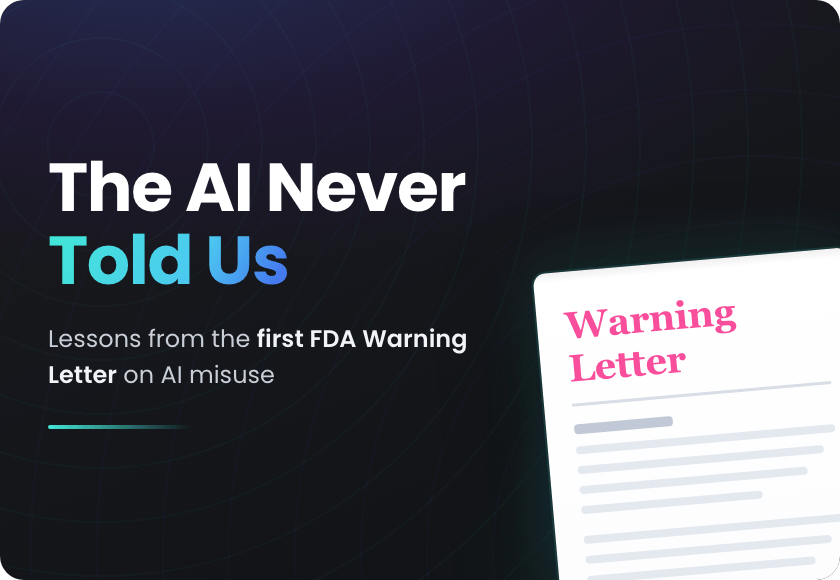
In 2026 FDA cited a drug manufacturer for relying on AI agents to generate drug product specifications, procedures and master production records without adequate quality unit review. The letter cited 21 CFR 211.22(c) and 211.100. FDA left room for AI in cGMP work and made clear that AI-generated outputs must be reviewed and approved by the quality unit (DLA Piper analysis; FDA warning letter). Mareana’s whitepaper, The AI Never Told Us, examines the letter in detail.
The EU is writing AI into GMP
The draft EU GMP Annex 22 on artificial intelligence went to consultation from 7 July to 7 October 2025. Final text is targeted for Q4 2026, as a work-plan target, not a confirmed date. The draft allows static, deterministic models in GMP-critical applications and keeps generative AI and large language models to non-critical uses with human oversight. A revised Annex 11 on computerised systems was released alongside it, expanding from 5 to 19 pages and making cybersecurity a formal GMP requirement (PharmaNow;).
FDA is defining how to trust an AI model
FDA’s January 2025 draft guidance on using AI to support regulatory decisions for drugs and biologics introduces a risk-based credibility assessment. It is tied to each model’s context of use (FDA).
Validation is becoming risk-based
FDA finalized its Computer Software Assurance guidance in September 2025. It applies to production and quality system software for medical devices (FDA). Pharma teams are applying the same risk-based thinking through GAMP 5 (second edition): concentrating testing on functions that affect product quality and patient safety.
AI is moving from pilots to governed assistants
The AI that is reaching production in GMP environments shares three traits. It works on contextualized data, it cites the source record behind every output, and a person approves the result. Review by exception and investigation assistants grounded in knowledge graphs are the clearest examples.
More manufacturing runs through external partners
Sponsors increasingly rely on CDMOs while remaining accountable for every batch they release. This makes data from external partners a central digital transformation problem, covered in section 12.
4. Pharma manufacturing systems, then and now
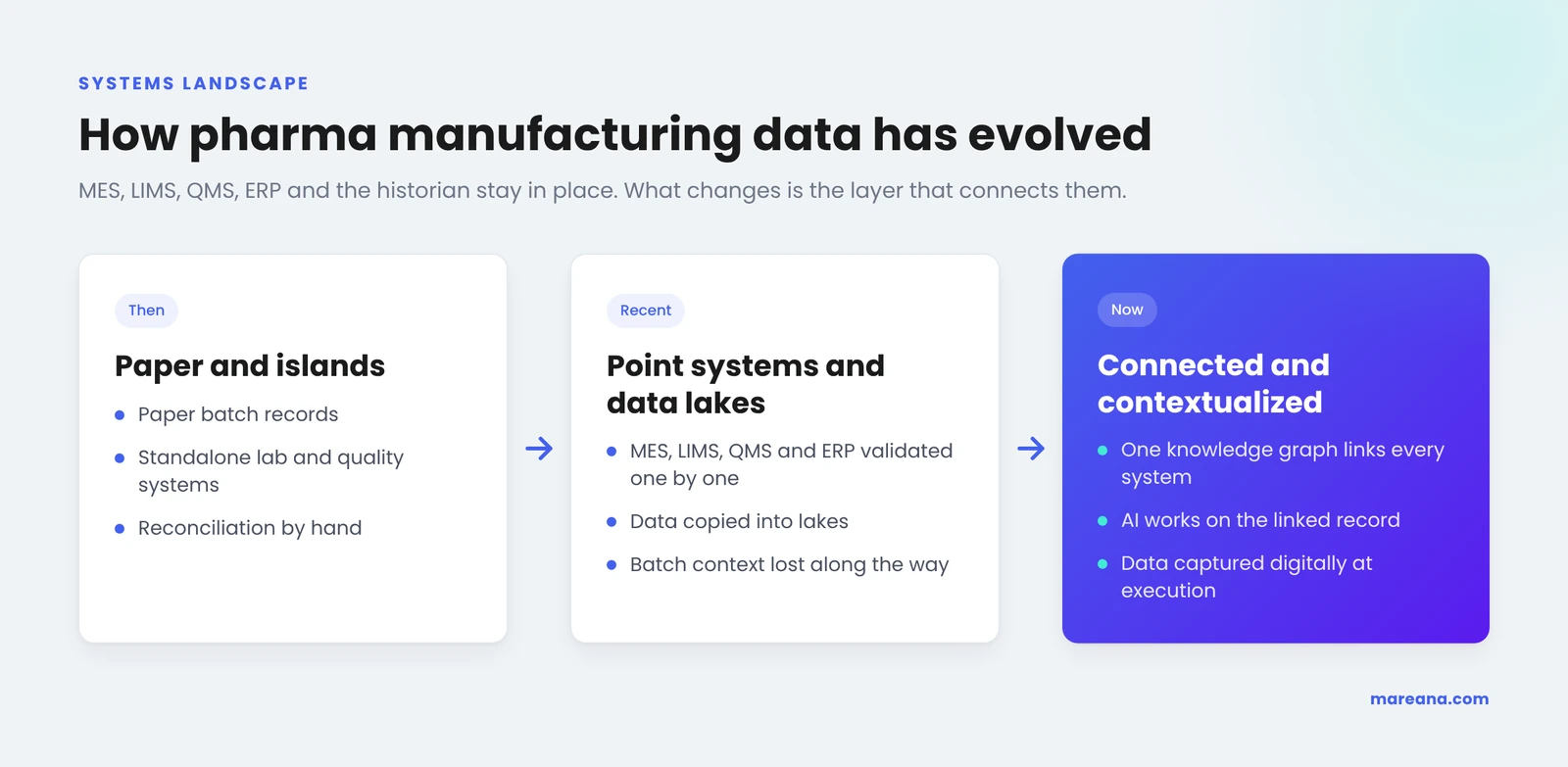
Most pharma plants run five core systems: an MES for execution, a LIMS for lab results, a QMS for deviations and CAPAs, an ERP for materials and lots, and a historian for sensor data. Each works well on its own. Digital transformation in 2026 connects them, together with paper records, into one contextualized view of each batch without replacing validated systems.
Three eras of pharma manufacturing data
- Paper and islands. Batch records on paper, standalone lab and quality systems, and reconciliation by hand.
- Point systems and data lakes. MES, LIMS, QMS and ERP validated one by one, with data copied into lakes and warehouses that store it but lose the batch context.
- Connected and contextualized (now). A data foundation that links the existing systems, AI applications that work on that foundation, and data captured digitally at the point of execution.
What each system holds, and what it misses on its own
| System | What it holds | The gap when it stands alone |
|---|---|---|
| MES | Recipes, execution steps, equipment use | Knows how the batch ran, not what the lab found |
| LIMS | Test results, specifications, samples | Results without process context |
| QMS | Deviations, CAPAs, change control | Events not linked to the batch data behind them |
| ERP | Materials, lots, inventory, release status | Lot movement without quality evidence |
| Historian | Time-series sensor data | High volume, no batch or phase labels |
| Paper records and CoAs | Executed batch records, supplier certificates | Cannot be searched, often held at a CDMO |
None of these systems needs to be replaced for digital transformation to work. What they lack is a shared layer that knows how their records relate to the same batch.
5. Why digital transformation in pharma stalls
These are the problems quality and manufacturing IT teams describe most often:
- Data in silos. Batch IDs in the LIMS do not match the MES, timestamps are misaligned, and the same material has different codes in different systems. Every cross-system question becomes a reconciliation project.
- Paper persists, especially at CDMOs. Sponsors receive executed batch records and certificates of analysis as scanned PDFs. The information is there, and none of it can be queried or trended.
- Electronic batch record projects rebuild the process. Many EBR programs spend most of their time redesigning approved paper processes as new electronic forms, then validating the copy.
- Batch review is manual. QA reviewers check every field of every record, so release time grows with batch volume.
- Investigations start with data collection. Before anyone can work on root cause, someone has to pull results from the LIMS, events from the QMS and parameters from the MES and historian.
- The validation tax. Every new report, interface or configuration change triggers documentation and testing, so teams avoid changes that would help.
- AI that cannot pass an inspection. Models that produce answers without a trail back to source records cannot support a GxP decision.
- A new data model for every site or product. Integrations built around one molecule or site have to be rebuilt when a product moves between sites or to a CDMO.
The following sections address each of these in turn.
6. Data lake, data foundation and knowledge graph
Data lake: a central store that holds data from many systems in its original form. It is efficient for volume and cost, and the relationships between records have to be reconstructed each time a question is asked.
Data foundation: the governed, contextualized layer that every report, application and AI model draws from. It holds one trusted version of each batch, with lineage and access controls.
Knowledge graph: a way of storing data as entities (batches, lots, equipment, tests, deviations) and the relationships between them. Relationships are stored once and reused by every query.
Read this blog ” Data Foundations for AI in Pharma” to know more.
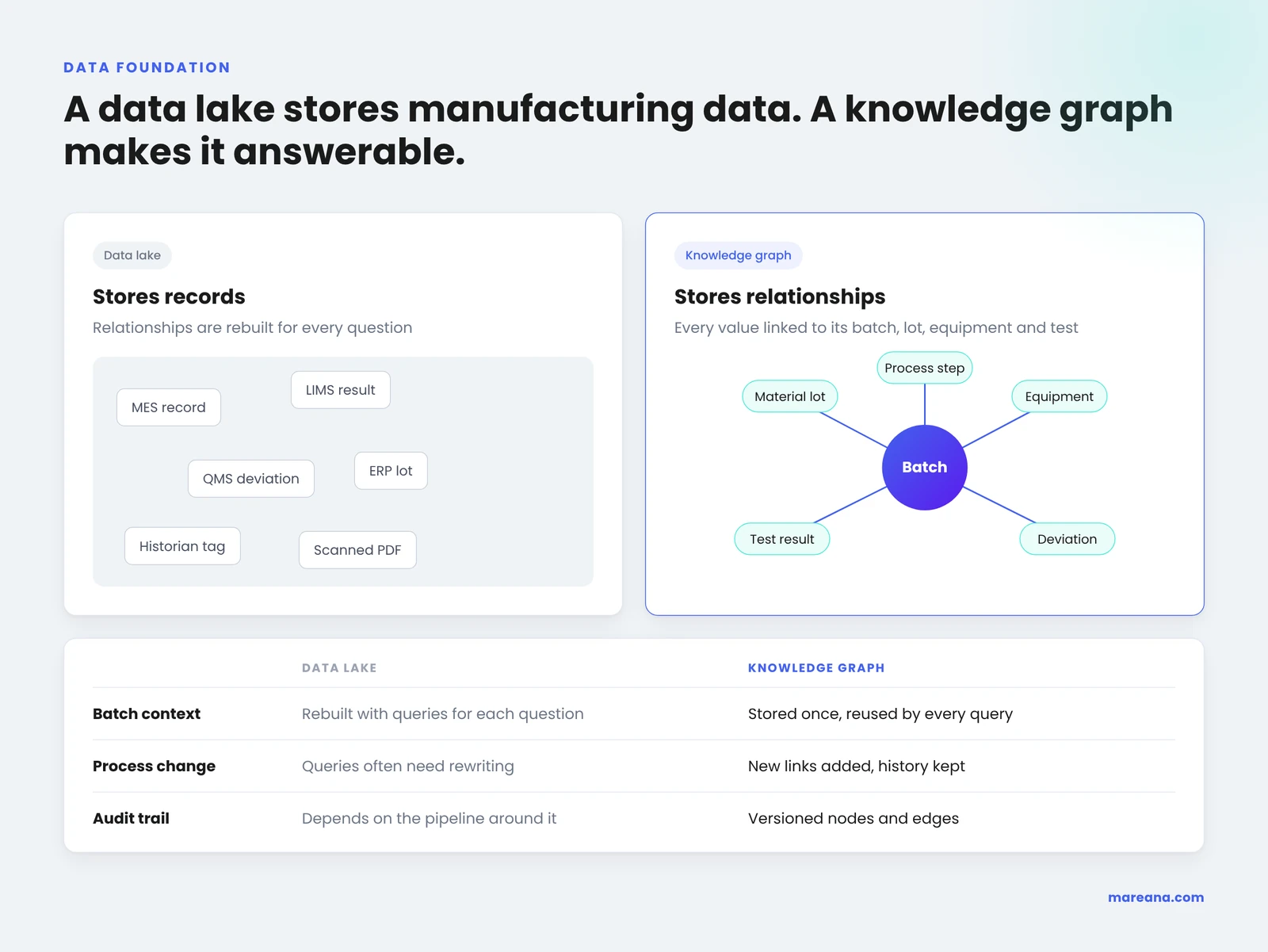
| Data lake | Knowledge graph as the data foundation | |
|---|---|---|
| Stores | Records as they arrive | Entities and their relationships |
| Batch context | Rebuilt with queries for each question | Stored once, reused everywhere |
| Recipe or process change | Queries often need rewriting | New relationships are added; history stays intact |
| Many-to-many links (one lot in many batches) | Complex joins | Native |
| Audit trail | Depends on the pipeline built around it | Versioned nodes and edges with change capture |
| Role in digital transformation | A useful source that can feed the foundation | The foundation itself |
Why knowledge graphs suit GxP manufacturing
- Manufacturing is relational. A single deviation can touch a material lot used in twelve batches across three campaigns. A graph answers that question by following stored links.
- History is preserved. Versioned nodes and edges keep every earlier state, which supports audit trails and reproducing past analyses for an annual product review.
- AI answers can be traced. When AI retrieves information by following validated relationships in a graph, each answer can cite the exact records it came from. That is the basis of trustworthy AI in GxP, covered in section 8.
A knowledge graph does not require replacing an existing data lake. Many organizations keep the lake for storage and analytics, and build the graph as the contextualized layer on top.
How Mareana handles this: Mareana’s platform is a GxP-compliant knowledge graph that connects MES, LIMS, ERP, QMS, historian and paper records, with 21 CFR Part 11 change capture. AI-driven relationship extraction links entities automatically, so teams do not write SQL or build data models by hand. It connects through APIs, connectors and database adapters and works with or without an existing data lake.
7. What contextualization means in practice
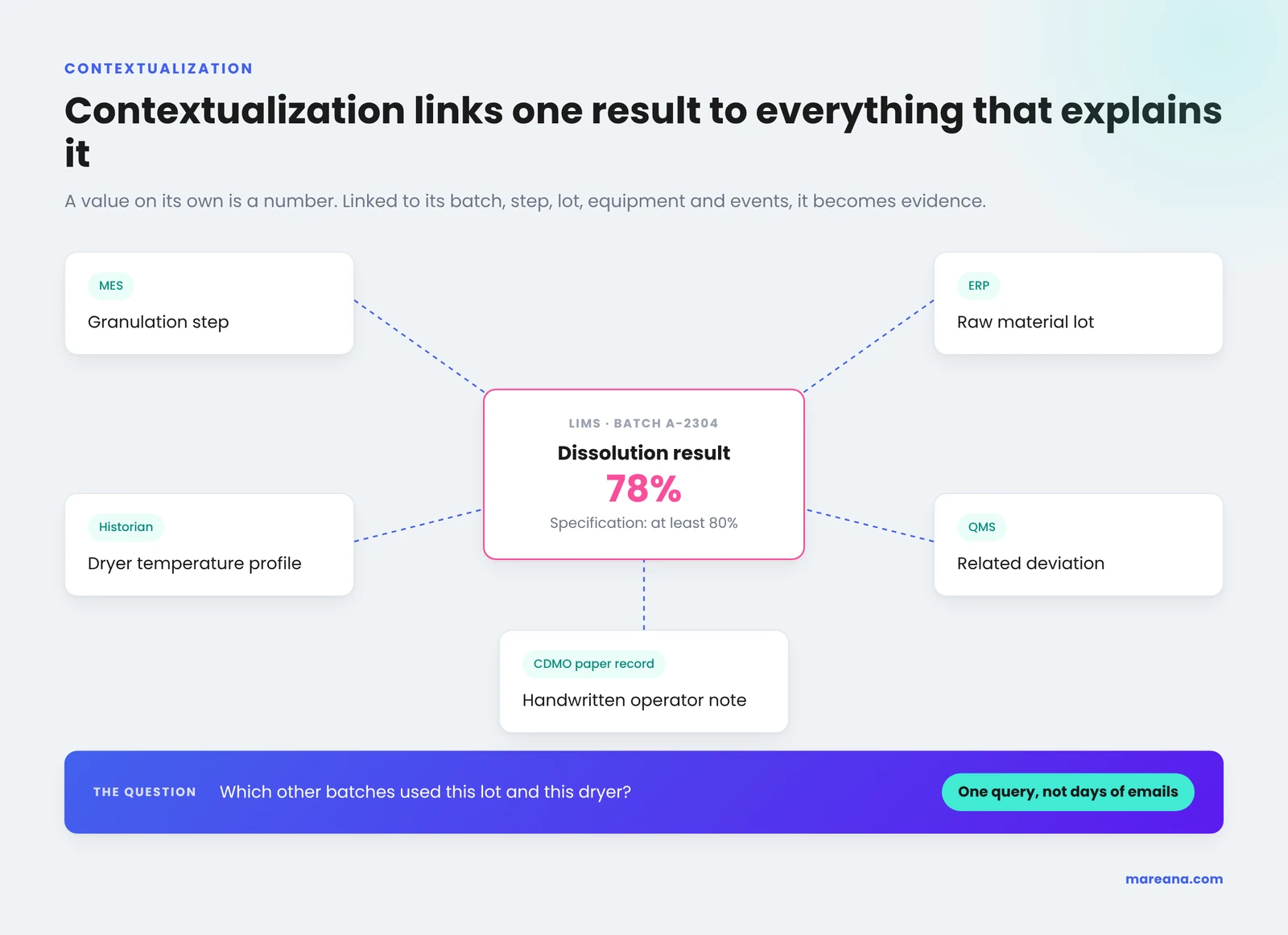
Contextualization in pharma manufacturing means linking every data point to the batch, process step, equipment, material lot and time it belongs to. A dissolution result in the LIMS becomes useful only when it is tied to the granulation step in the MES, the raw material lot in the ERP and any open deviation in the QMS. Contextualized data lets teams trace impact across batches in minutes.
A worked example
- A dissolution result for batch A-2304 comes back at 78% against a specification of at least 80%.
- On its own, that is one number in the LIMS.
- Contextualized, it is linked to the granulation step recorded in the MES, the raw material lot in the ERP, the dryer temperature profile in the historian, a related deviation logged last month in the QMS, and a handwritten note on the CDMO’s paper batch record.
- The question “which other batches used this lot and this dryer?” now takes one query instead of days of emails and spreadsheet work.
Five kinds of context
- Material lineage: which lots went into which batches, forward and backward. This is batch genealogy.
- Process context: which phase and step a value belongs to.
- Quality events: the deviations, CAPAs, results and changes linked to a batch.
- Time alignment: timestamps from different systems placed on one timeline.
- Master data: IDs and names that agree across systems.
Batch genealogy: the complete digital record of a batch’s lineage, from raw materials through each unit operation to finished product, including every material, parameter, deviation and decision along the way.
How Mareana handles this: Mareana Batch Genealogy links parent and child entities automatically and normalizes IDs and timestamps across ERP, MES, LIMS and historian data. Paper Batch Record Digitization turns paper records and certificates of analysis into nodes in the same graph, so context reaches records that started on paper. Teams can isolate the impact of an issue.
8. How AI is used in pharma manufacturing today
AI in pharma manufacturing is used most today to extract data from paper batch records, review batch records by exception, investigate deviations across systems, and trend process data for continued process verification. In each case the AI proposes and a person decides. The most reliable systems ground AI in a knowledge graph of linked batch records, so every output cites the source record it came from.
The useful way to think about AI in a GMP operation is by the job it does across a batch’s life. For each job, three questions matter: what the AI does, what the person does, and what keeps the result compliant.
| AI job | What the AI does | What the person does |
|---|---|---|
| Extract | Reads handwriting, checkboxes, signatures and tables from paper records, with a confidence score per field | Confirms low-confidence fields |
| Draft | Converts an approved paper master into digital entry screens, once | Approves every screen before release |
| Review | Runs rule checks and flags drift against historical batches | Reviews flagged exceptions and signs |
| Investigate | Answers plain-language questions across systems, citing each source record | Determines root cause and approves the CAPA |
| Trend | Applies SPC rules to live process data and routes alerts | Owns the response and the product review |
| Analyze | Finds the parameters that drive yield, cycle time and variability | Decides which process change to make |
Extracting data from paper batch records
Paper remains common in pharma, particularly in batch records executed at CDMOs. AI document models trained on pharmaceutical records read handwritten entries, checkboxes, signatures, margin notes and nested tables, and assign a confidence score to every field. Low-confidence fields go to a person to confirm, and each extracted value keeps a link to its place on the source page.
How Mareana handles this: Paper Batch Record Digitization uses pharma-tuned vision models with field-level confidence scoring and human-in-the-loop validation, and normalizes vendor certificate of analysis formats into one schema. Drafting electronic batch records from approved masters
AI can shorten electronic batch record projects by drafting the digital entry screens directly from the approved paper master batch record. A person reviews and approves every screen before release, and the approved template is versioned through existing change control.
How Mareana handles this: EBRx uses AI once, to draft the screens from the approved paper master. Site reviewers approve them before anything reaches the floor. During execution, batches run on fixed, deterministic rules, and EBRx checks equipment logs, cleaning records, material release status and quality holds before each step can proceed.
Reviewing batch records by exception
Review by exception: a batch record review approach in which a rule engine and anomaly detection check every parameter automatically, and QA reviewers examine only the items that fall outside specification or show unusual patterns.
How it works:
- Connectors pull values from the MES, LIMS, ERP and scanned records.
- The data is standardized into consistent formats.
- A rule engine checks ranges, signature completeness and calculations such as potency and yield.
- Anomaly detection compares values with historical distributions to flag drift that is still within specification.
- Every check, decision and revision is written to an audit trail.
- The reviewer sees only the flagged items, each with its source snippet, and approves with an electronic signature.
How Mareana handles this: Batch Review Copilot traces every result from value to rule to verdict to e-signature, and routes approvals by role.
Investigating deviations with AI
Most of a deviation investigation is collecting evidence from several systems before anyone can analyze it. AI investigation assistants let investigators ask a question in plain language, such as “which batches used this lot and were dried on this equipment?”, and return the answer with its sources.
How the assistant retrieves information decides whether its answers can be trusted in GxP.
GraphRAG: retrieval-augmented generation that finds information by following relationships in a knowledge graph, such as batch to lot to equipment to test, instead of by matching similar-looking text.
| Vector RAG | GraphRAG | |
|---|---|---|
| How it finds information | Text that looks similar to the question | Validated relationships between records |
| Answer traceability | Passages that may come from different contexts | A path through specific, linked records |
| Hallucination risk | Possible | Minimized |
| Suitability for GxP investigations | Limited | Strong, with human review |
How Mareana handles this: Lumis is an AI co-pilot for manufacturing investigations built on GraphRAG. It converts a plain-language question into a structured query over the knowledge graph and returns answers attributed to specific records. For example, a low dissolution result is traced to lab result LR-44817, batch record BR-A2304 and MES record MES-99213.
Trending process data for continued process verification
Continued process verification depends on charts that stay current as batches complete. AI and statistical automation apply control rules to live data, flag trends before they become out-of-trend events, and route alerts to the owner. The same charts can be reproduced later for an annual product review.
How Mareana handles this: Charts automates CPV and SPC with Nelson rules 1 to 8, Westgard and WECO rules, and calculates process capability using validated logic. Lumis then helps teams investigate the anomalies the charts surface. AI analysis of manufacturing data
Once batch data is contextualized, machine learning and multivariate analysis can find the combinations of parameters that drive yield, cycle time and variability across hundreds of batches. This is where digital transformation produces its largest financial returns.
Other AI uses in pharma manufacturing
- Predictive maintenance: models on equipment sensor data that forecast failures before they interrupt a campaign.
- Process analytical technology (PAT): inline sensors such as NIR and Raman, combined with multivariate models, to monitor critical quality attributes during processing.
- Digital twins: models of equipment or processes, kept in step with plant data, for testing changes virtually.
- Supply chain planning: AI that senses demand and supply changes across the network. Mareana’s VSM applies this to end-to-end supply chain visibility.
All of these depend on the same thing: contextualized data that the model can trust. Read our deep dive on AI in Pharma Manufacturing.
What makes manufacturing AI trustworthy
- It works on contextualized data with known lineage.
- Every output cites the records it came from.
- A qualified person reviews and approves before any GxP decision.
- The model has a defined intended use, is locked in use, and changes only through change control.
9. Where AI must not act in GxP manufacturing
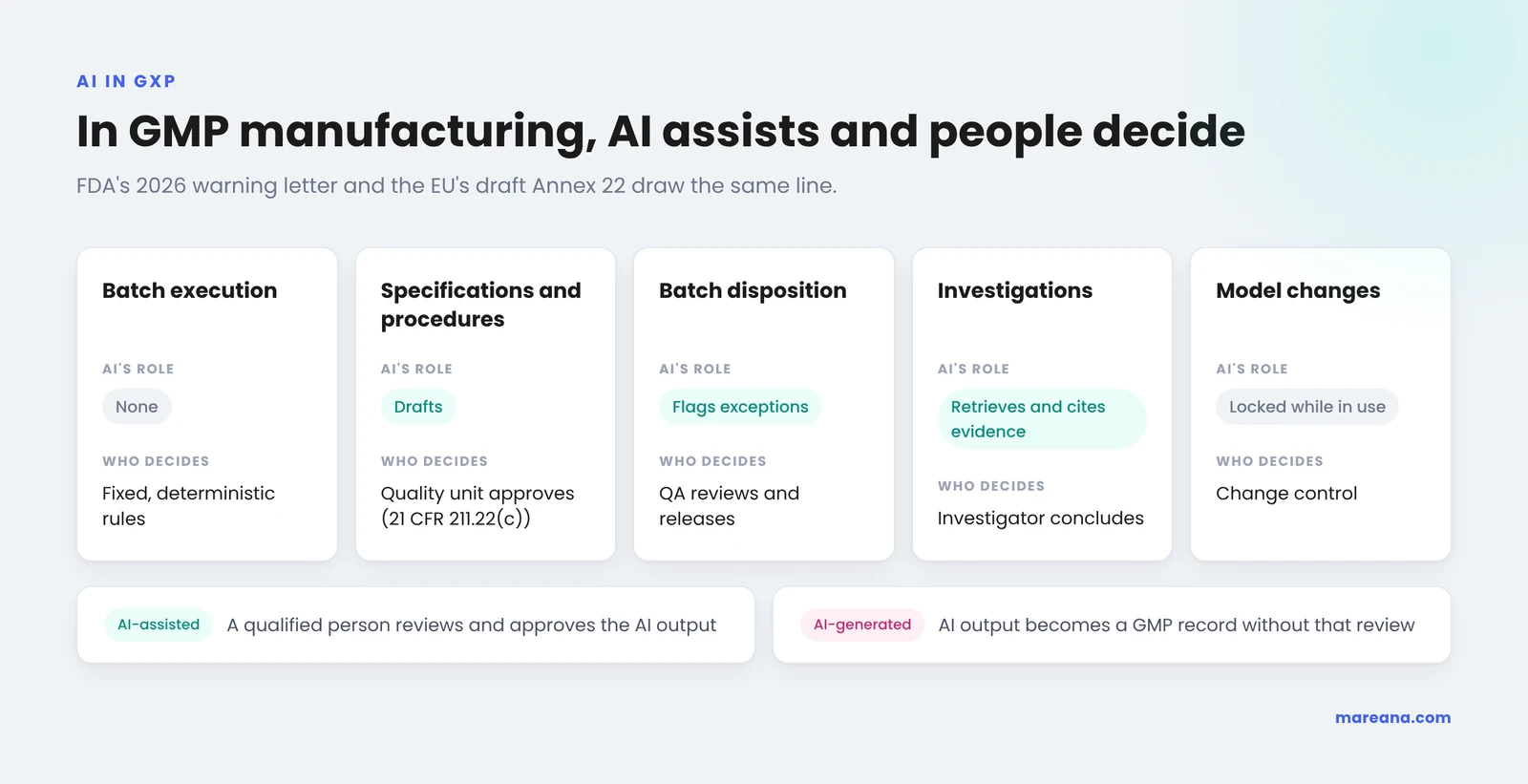
AI is allowed in GMP manufacturing as an assistant to the decision-maker. FDA’s 2026 warning letter and the EU’s draft Annex 22 point the same way: AI can draft, extract, flag and retrieve, and the quality unit approves specifications, procedures and batch release. Batch execution should run on deterministic rules, and any model used in a critical decision should be locked and changed only under change control.
The line regulators are drawing is about accountability. Under 21 CFR 211.22(c), the quality unit approves or rejects every procedure and specification that affects identity, strength, quality or purity, whoever or whatever drafted it. The draft Annex 22 adds a technical boundary: in GMP-critical uses, models should be static and deterministic, and generative AI should stay in non-critical roles with human oversight.
| GxP activity | AI’s role | Why |
|---|---|---|
| Executing a batch on the floor | None: deterministic rules only | The same input must give the same result on batch one and batch one thousand |
| Specifications, procedures and master records | Draft only | 21 CFR 211.22(c): the quality unit approves |
| Batch disposition | Flag exceptions and assemble evidence | Release is a quality unit decision |
| Investigation conclusions | Retrieve and cite evidence | Root cause is a human judgement |
| Changes to a model used in a critical decision | None while in use; updates through change control | Draft Annex 22 favors static, deterministic models in critical uses |
AI-assisted and AI-generated are different things
An AI-assisted record is one a qualified person drafted, checked or approved with AI’s help, and the person’s review is documented. An AI-generated record is one where AI output became a GMP document without that review. The 2026 warning letter concerned the second kind: staff told investigators they had not known about certain requirements because the AI tool had not flagged them.
How Mareana designs for this boundary
- EBRx: “AI drafts the screens once, and a person approves them.” Batches then run on fixed, deterministic rules, with no AI during execution.
- Batch Review Copilot: AI flags exceptions, and dual approval workflows route the release decision to the right people, with electronic signatures and an immutable audit trail.
- Lumis: answers are attributed to the specific records they came from. The investigator draws the conclusion.
- Model governance: training datasets and model versions are logged.
10. GxP compliance challenges and how to handle them
The hardest GxP compliance problems in digital manufacturing are data integrity across disconnected systems, producing evidence quickly during an inspection, oversight of paper records held by contract manufacturers, and governing AI. The common fix is one linked, version-controlled record per batch, with a full 21 CFR Part 11 audit trail, that the quality unit can query and approve.
| Challenge | Regulatory anchor | How to handle it |
|---|---|---|
| Data integrity across disconnected systems | 21 CFR Part 11, EU GMP Annex 11, ALCOA+ principles | One linked record per batch with change capture, role-based access and tamper-evident logs |
| Producing evidence during an inspection | Part 11 audit trail requirements | Retrieve the answer from linked data instead of rebuilding it from several systems |
| Paper records held at CDMOs | 21 CFR 211.22: the sponsor’s quality unit remains responsible | Digitize CDMO records on arrival and link them to internal data |
| Validation effort on every change | GAMP 5 (second edition), risk-based | Configure once, version templates, and validate the change instead of the whole system |
| Annual product reviews and CPV | 21 CFR 211.180(e); FDA process validation guidance, stage 3 | Automated, reproducible charts and reports from contextualized data |
| AI governance | 21 CFR 211.22(c); FDA draft AI guidance; draft EU Annex 22 | A model inventory, defined intended use, human approval, models locked in use |
| Cybersecurity of connected systems | Draft revised Annex 11 | Treat access control, segmentation and incident response as GMP controls |
11. Digital readiness in pharma: a five-level model
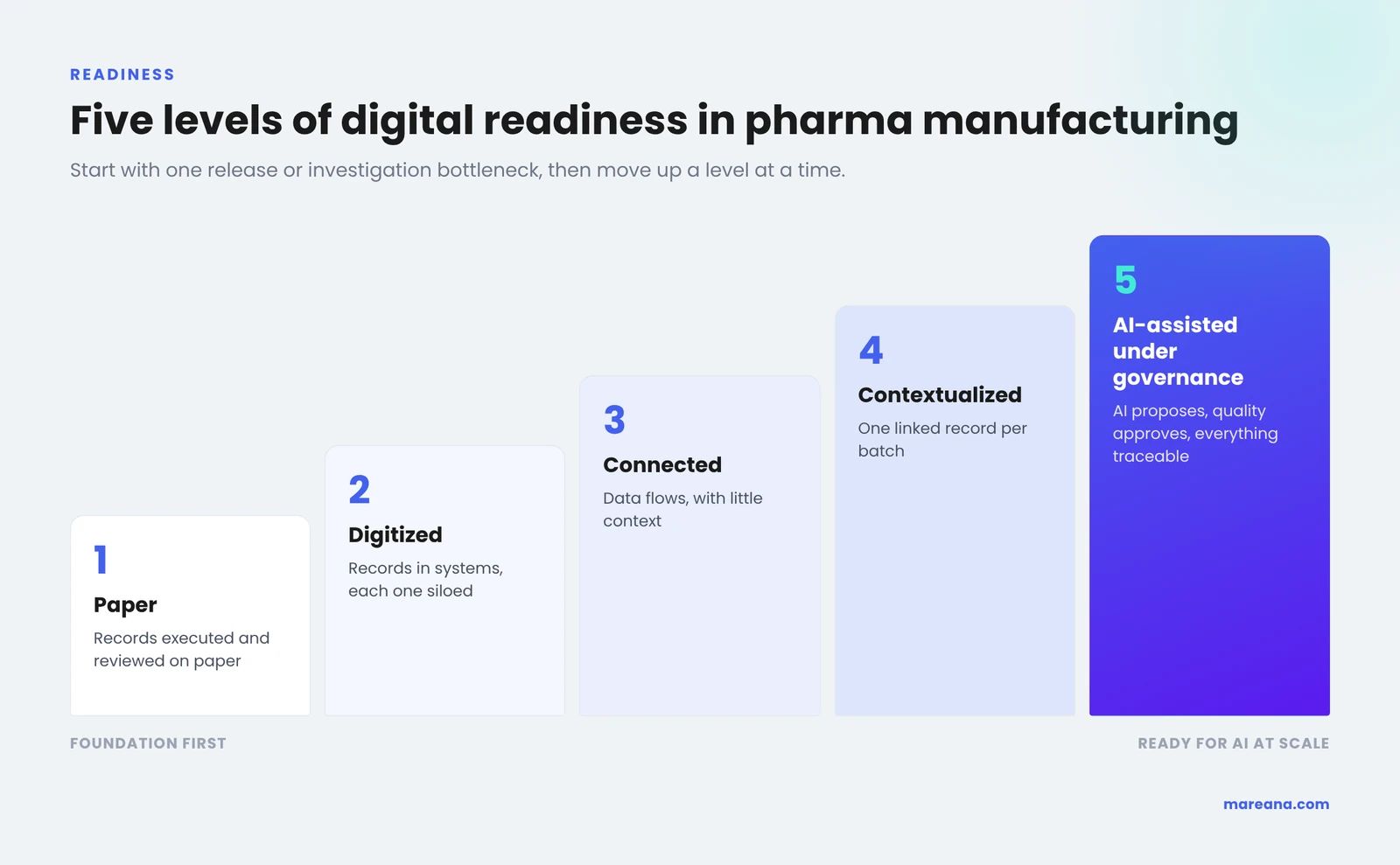
A pharma manufacturer is ready for AI when every batch has one linked, contextualized record across MES, LIMS, QMS, ERP and paper, and its quality unit can approve and trace every AI-assisted output. Most companies sit between digitized and connected. The fastest path forward starts with one release or investigation bottleneck and expands from there.
How digital transformation is affecting pharma in 2026
- Inspections are moving from documents to data. Being able to show a batch’s history on request is becoming a compliance capability in its own right.
- AI pilots are being re-scoped. After the 2026 warning letter, unsupervised generation of GMP documents is giving way to human-approved, source-cited assistance.
- Sponsors want data from CDMOs. Quality agreements are starting to specify structured data, beyond documents.
- Point tools are being consolidated. Teams running separate tools for SPC, genealogy, review and reporting are moving to shared platforms to cut integration and validation effort.
The five levels
| Level | What it looks like | Next step |
|---|---|---|
| 1. Paper | Executed records on paper, reviewed by hand | Make paper queryable and capture new data digitally |
| 2. Digitized | Records in systems, each one siloed | Link systems at batch level |
| 3. Connected | Data flows between systems with little context | Contextualize by batch, step and lot |
| 4. Contextualized | One linked record per batch | Apply AI to review and investigation |
| 5. AI-assisted under governance | AI proposes, quality approves, everything is traceable | Scale across sites and CDMOs |
A six-step roadmap
- Assess where each site and CDMO sits on the five levels.
- Pick one bottleneck, such as batch release time or deviation cycle time, that has a clear owner and a measurable baseline.
- Connect the sources behind that bottleneck into a contextualized foundation.
- Digitize the paper that feeds it, including CDMO records.
- Deploy AI with an approval gate, a defined intended use and an audit trail.
- Scale to the next bottleneck, site or CDMO, reusing the same data model.
How long does digital transformation take in pharma?
A full transformation runs for years, but value should not wait that long. Scoping work to one bottleneck makes it realistic to see measurable results within months. Platform deployments that reuse existing systems are faster than programs that replace them.
KPIs to track
| KPI | What it shows |
|---|---|
| Batch review time | Effort per batch record review |
| Batch release cycle time | Time from batch completion to disposition |
| Deviation investigation cycle time | Time from deviation to approved root cause |
| CPV reporting effort | Hours spent producing trend reports |
| Audit evidence retrieval time | Minutes to answer an investigator’s request |
| Share of records that are queryable | Progress away from paper and PDFs |
12. Digital transformation across a CDMO network
For virtual and asset-light pharma, digital transformation means getting usable, linked data from contract manufacturers without owning their systems. Sponsors digitize CDMO batch records and certificates of analysis on arrival, map every site onto one batch model, and review by exception. Under 21 CFR 211.22, the sponsor’s quality unit remains accountable for release, whoever produced the batch.
A sponsor’s version of digital transformation looks different from a plant owner’s. The sponsor does not choose the CDMO’s MES or historian, and its quality unit still signs off every batch it releases.
Four problems sponsors face
- Data arrives as documents. Executed batch records, certificates of analysis and deviation reports come as scanned PDFs or paper, so nothing can be queried or trended.
- Every CDMO is different. Each site has its own formats, IDs and templates, so comparing the same product across two CDMOs means manual reconciliation.
- Review happens at a distance. QA reviews batches it did not witness, against records it did not design, often under release-date pressure.
- Accountability stays with the sponsor. The quality unit remains responsible under 21 CFR 211.22 and FDA’s quality agreements guidance. The 2026 warning letter reinforces that a third party or a tool drafting a document does not move the approval.
What good looks like
- CDMO paper and PDFs become structured, linked data when they arrive.
- Records from every CDMO map onto one batch model, so a product can be trended across sites.
- QA reviews by exception, with every flag traced to the CDMO’s source page.
- Genealogy runs across sponsor and CDMO records, so one query answers “which batches used this lot?”
- Quality agreements specify the data the CDMO delivers, in addition to the documents.
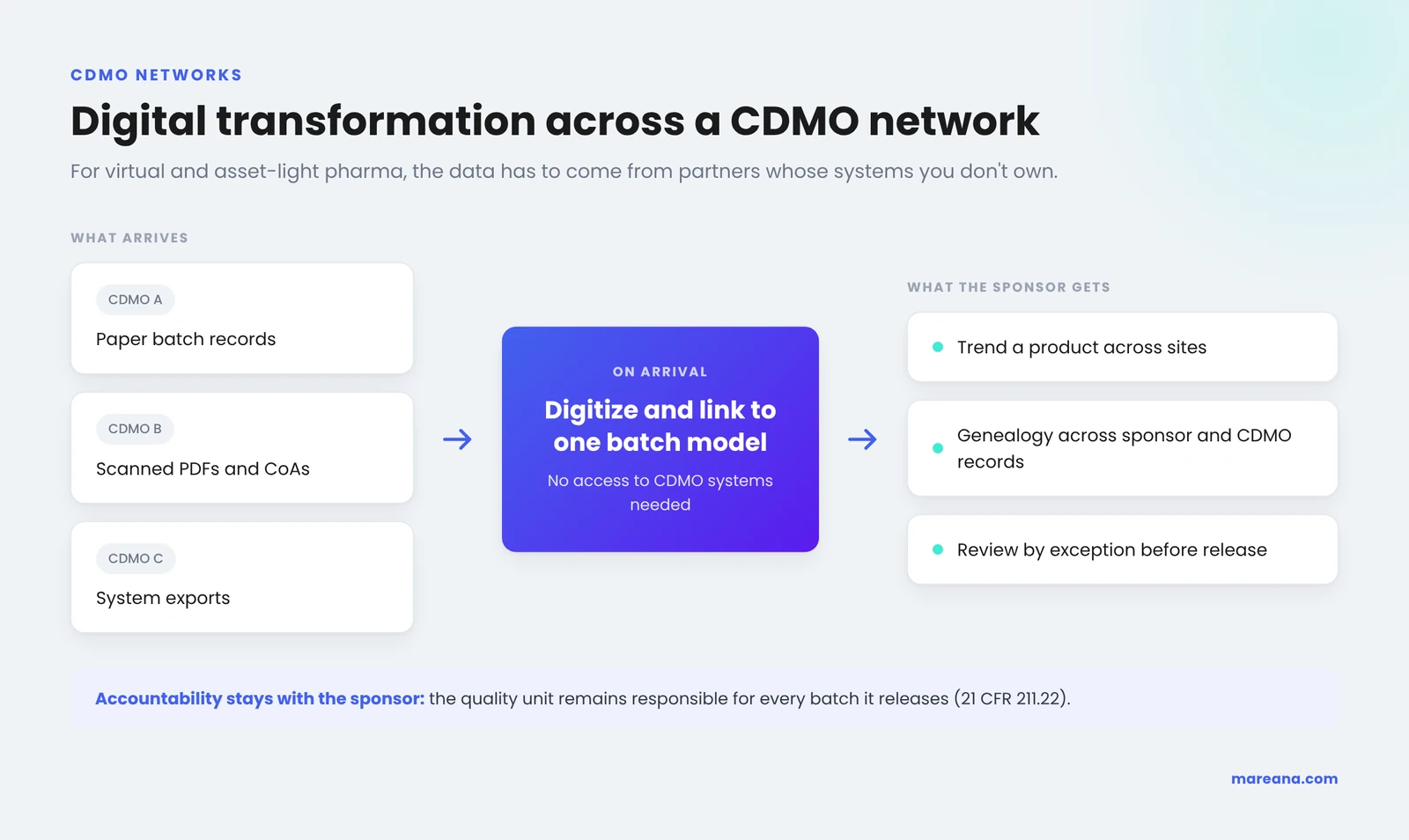
How Mareana handles this: Paper Batch Record Digitization extracts handwriting, checkboxes and signatures from CDMO batch records and normalizes certificate of analysis formats into one schema. Batch Genealogy works from paper records alone, built for virtual pharma teams that rely on CDMO paper. Batch Review Copilot applies review by exception to CDMO batches. Because the platform does not need a bespoke data model per site, moving a product between CDMOs, or from external to internal manufacturing, does not restart the integration.
13. How Mareana approaches digital transformation
Mareana is a pharma manufacturing intelligence platform built on a GxP-compliant knowledge graph. It connects MES, LIMS, ERP, QMS, historian and paper records, then runs AI applications on that foundation: paper digitization, batch review by exception, batch genealogy, CPV charting, plain-language investigations with Lumis, and EBRx electronic batch records. Every output is traceable under 21 CFR Part 11.
How Mareana solves the problems that arise with legacy systems
- Analytics on manufacturing and supply data. Continued process verification, multivariate analysis and value stream mapping showed that connected data pays, including the yield, real-time release and overtime results in section 8.
- The data foundation. Analytics kept stalling on data preparation, so Mareana built the knowledge graph that connects MES, LIMS, ERP, QMS, historian and paper, with Part 11 change capture and automatic relationship extraction.
- AI applications on the graph. With trusted context in place, AI could do GxP work: Paper Digitization, Batch Review Copilot, Batch Genealogy, Charts and Lumis.
- Capture at the source. EBRx, now in open beta, records new batch data digitally from the approved paper master, checks it against backend systems in real time, and adds it to the genealogy graph from the first batch.
Most vendors own either the data layer or the application layer. Mareana covers the data foundation, the AI applications on it, and the point where batch data is first recorded.
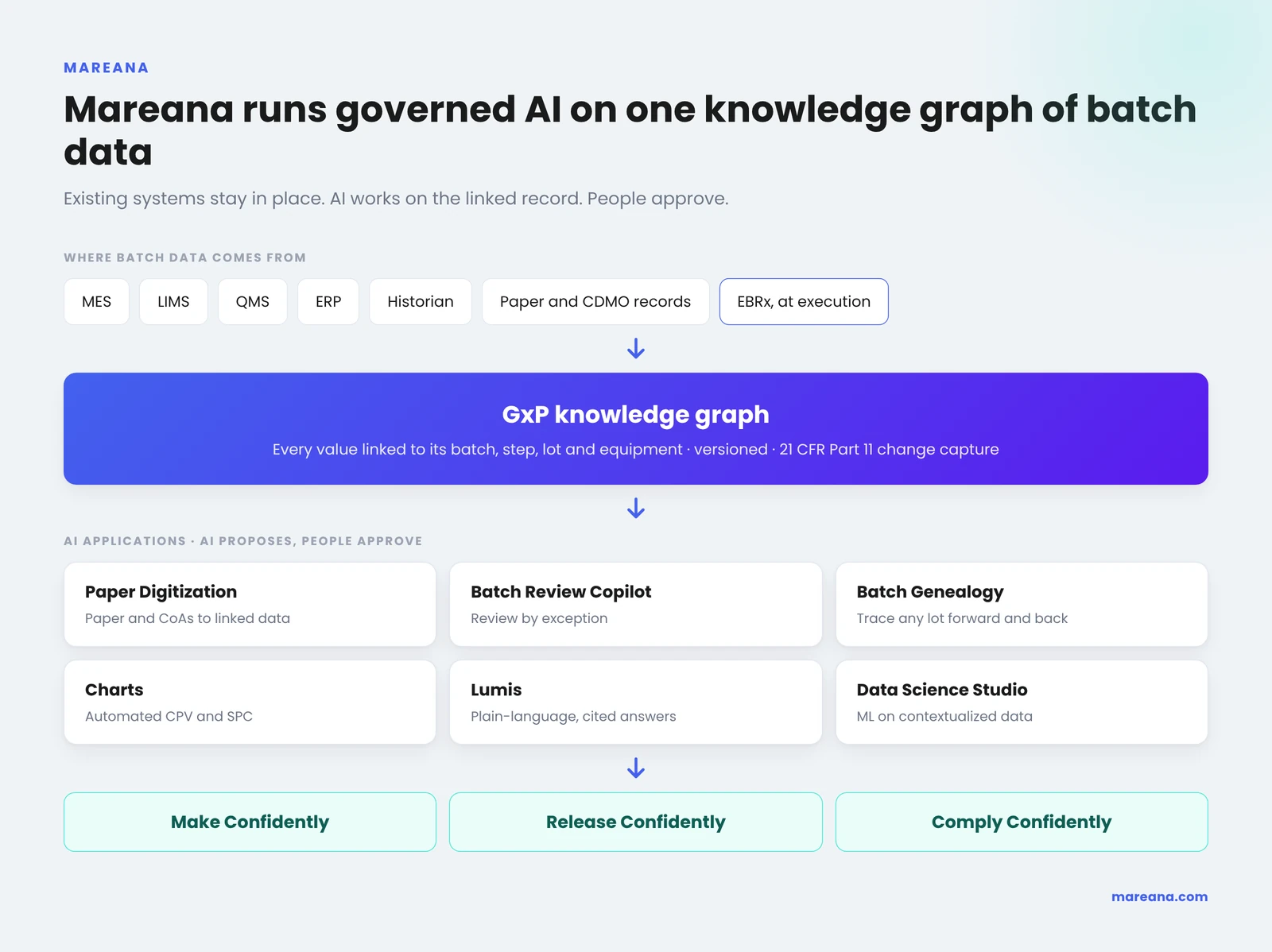
Mareana’s products at a glance
| Product | What it does |
|---|---|
| Paper Batch Record Digitization | Turns paper batch records and certificates of analysis into linked, audit-ready data |
| EBRx | Electronic batch record built from the approved paper master, with deterministic execution and real-time system checks |
| Batch Review Copilot | Reviews batch records by exception, with a Part 11 audit trail |
| Batch Genealogy | Forward and backward traceability across systems and paper |
| Charts | Automated CPV and SPC with built-in Nelson and Westgard rules |
| Lumis | Plain-language investigations over the knowledge graph, with cited sources |
| Data Science Studio | Python and machine learning workbench on contextualized data |
| Mareana VSM | AI data fabric for end-to-end supply chain visibility |
Frequently Asked Questions
Watch: How digital transformation is reshaping pharma manufacturing.
See it on your own batch record
Bring one page of a batch record. We will show you how Mareana turns it into linked, reviewable data, and what review by exception, genealogy and Lumis look like on your own process.

 Learn more